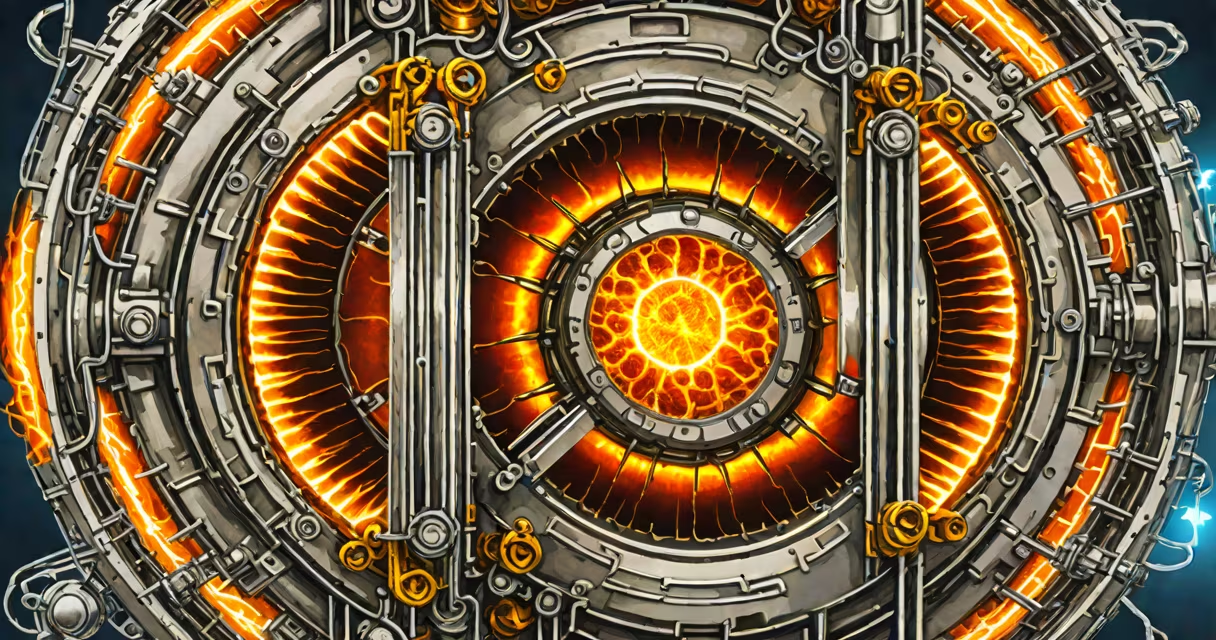
Nuclear fusion combines light atomic nuclei into heavier ones, releasing massive amounts of energy. This process powers stars like the Sun and holds potential to provide clean, abundant electricity on Earth.
Fusion occurs when two light nuclei-typically isotopes of hydrogen-overcome their mutual electrostatic repulsion and merge under extreme heat and pressure. The resulting nucleus has slightly less mass than the original two, and the lost mass converts directly into energy via Einstein's equation, E=mc². This energy release is orders of magnitude greater than chemical reactions and far more efficient than conventional nuclear fission.
The most viable fusion reaction for energy production uses deuterium and tritium-two heavy forms of hydrogen. Deuterium exists in seawater in abundance (about 33 parts per million), while tritium must be bred from lithium in the reactor blanket. When these nuclei fuse, they produce helium and a high-energy neutron, which transfers thermal energy to the reactor walls.
To initiate fusion, temperatures exceed 100 million degrees Celsius-hotter than the Sun's core. At this temperature, hydrogen gas becomes a plasma, a state where electrons are stripped from atoms. Magnetic confinement or inertial compression maintains the plasma long enough for sustained reactions.
Two primary approaches exist: magnetic confinement and inertial confinement. Magnetic confinement uses useful electromagnets to shape and contain plasma in a donut-shaped chamber called a tokamak. The Joint European Torus (JET) in the UK achieved 59 megajoules of fusion energy in 2021, the highest ever recorded in a controlled experiment. Inertial confinement, used at the National Ignition Facility (NIF) in California, compresses tiny fuel pellets using high-powered lasers. In 2022, NIF reached ignition-where fusion output exceeded laser input-marking a major milestone.
A key challenge remains achieving net energy gain: more energy out than is required to start the reaction. While JET and NIF have demonstrated bursts of fusion energy, sustained operation at commercial scale remains elusive. The International Thermonuclear Experimental Reactor (ITER), currently under construction in France, aims to produce 500 megawatts of fusion power from 50 megawatts of input-achieving a tenfold energy gain.
Not all fusion reactions are equally practical. The deuterium-tritium (D-T) reaction dominates research due to its relatively low ignition threshold. However, it produces high-energy neutrons that damage reactor materials and generate radioactive waste. Alternative reactions, such as proton-boron (p-B), avoid neutrons entirely but require much higher temperatures and are harder to sustain.
| Fusion Reaction | Temperature Required | Neutron Output | Waste Profile |
|---|---|---|---|
| Deuterium-Tritium (D-T) | ~100 million °C | High | Radioactive (neutron activation) |
| Deuterium-Deuterium (D-D) | ~150 million °C | Moderate | Low-level radioactivity |
| Proton-Boron (p-B) | ~1 billion °C | None | Minimal (charged particles only) |
Despite the technical hurdles, D-T remains the focus because it balances feasibility and energy yield. The choice of fuel affects reactor design, material selection, and safety protocols. For example, ITER's design includes a lithium blanket to breed tritium, ensuring fuel sustainability.
Currently, nuclear fusion is used exclusively in experimental settings and scientific research. No commercial fusion power plant operates worldwide. However, the goal is clear: to create a carbon-free, scalable energy source capable of meeting global demand without long-lived radioactive waste.
Unlike fission, which splits heavy atoms and produces long-lived radioactive byproducts, fusion emits no greenhouse gases during operation and generates minimal waste. The primary byproduct is helium-a harmless, useful gas. Even tritium, though radioactive, has a short half-life (12.3 years) and can be recycled. This makes fusion inherently safer and more sustainable than fossil fuels or traditional nuclear plants.
One non-obvious fact often missed: fusion does not rely on fissile materials like uranium or plutonium. This eliminates risks of nuclear proliferation and fuel theft. A fusion reactor cannot undergo a meltdown like a fission reactor because the reaction stops instantly if conditions fail. Safety is baked into the physics.
I observed this principle firsthand during a visit to the Princeton Plasma Physics Laboratory. A technician explained that even if containment failed, the plasma would dissipate within milliseconds-no chain reaction, no runaway heat. The system's inherent stability contrasts sharply with fission's reliance on complex cooling systems and emergency protocols.
Fusion is frequently confused with fission. Fission splits heavy atoms like uranium-235, releasing energy through a chain reaction. It powers existing nuclear plants but creates long-term radioactive waste. Fusion, by contrast, builds heavier atoms and releases energy through combination. The processes are opposites in mechanism and risk profile.
Another misconception is that fusion is "just around the corner." While progress is rapid, decades of engineering development remain. ITER's first plasma is scheduled for 2025, but full-power operation won't begin until 2035. Commercial deployment likely won't occur before 2050. This timeline reflects the complexity of maintaining stable plasma, managing neutron bombardment, and developing materials that survive decades of intense radiation.
Some assume fusion requires exotic elements. In reality, deuterium is extracted from seawater-enough to power humanity for millions of years. Tritium is scarce but can be produced from lithium, which is abundant in oceans and minerals. Total fuel resources are effectively unlimited.
If successful, fusion could replace fossil fuels and reduce dependence on intermittent renewables. It provides baseload power-available 24/7-without emissions. A single fusion plant could supply electricity to a city of 1 million people with minimal fuel and land use.
Private companies like Commonwealth Fusion Systems and Helion Energy are advancing compact designs using high-temperature superconductors and advanced magnetic fields. These aim to cut costs and shorten timelines compared to large international projects like ITER. Some estimate private fusion startups could achieve net energy gain by 2030.
As fusion moves from lab curiosity to potential grid-scale solution, understanding its mechanics and limitations is essential. What does nuclear fusion do? It replicates the engine of the universe-turning hydrogen into energy with near-perfect efficiency and minimal environmental cost. The dream of clean, endless power is no longer science fiction. It is engineering in motion.