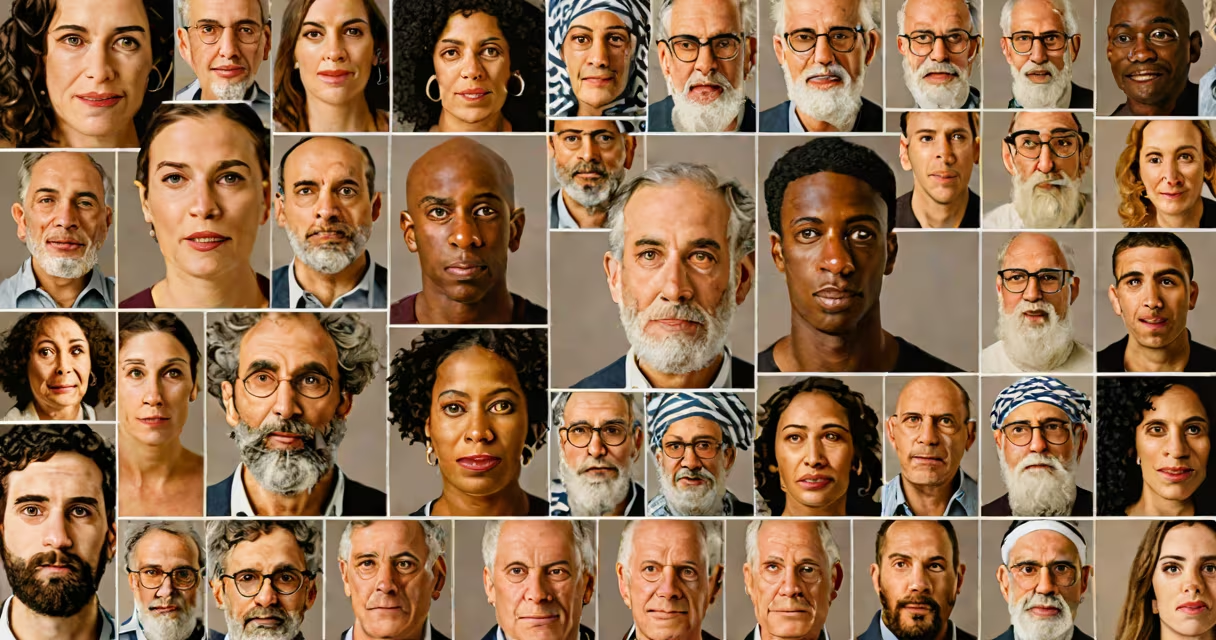
"What does it mean to look Jewish" refers to the assumption that certain physical traits-such as a prominent nose, dark curly hair, or specific facial bone structure-are markers of Jewish identity, despite no biological basis for such a connection. These perceptions stem from centuries of cultural, religious, and racial stereotyping rather than genetics.
The idea that Jews "look a certain way" emerged during the medieval period in Europe, when visual cues were used to identify religious minorities. Jews were often forced to wear distinctive clothing or badges, but over time, facial features became symbolic identifiers in art, literature, and propaganda. By the 19th century, pseudoscientific theories like phrenology and racial hierarchies began linking physical appearance to supposed moral or intellectual traits, embedding these ideas into public consciousness.
Today, the phrase persists in casual conversation, online discourse, and media portrayals. People may comment on someone's "Jewish look" based on perceived features, even when the individual has no religious or ethnic connection to Judaism. This reflects a broader pattern of equating appearance with identity-a practice that applies across many cultures but holds particular weight in contexts of antisemitism and marginalization.
"Looking Jewish" operates through a system of visual shorthand. When someone describes another person as "looking Jewish," they're drawing on a shared cultural structure of expectations, not objective criteria. The concept relies on subjective interpretation shaped by history, media exposure, and social conditioning.
For example, a person with a hooked nose might be described as "looking Jewish" in a casual comment. But this trait appears across many populations-Middle Eastern, Mediterranean, Central Asian, and European-due to genetic variation. The association is not biological but cultural. A 2018 study published in *Social Psychological and Personality Science* found that participants consistently identified individuals with certain facial features as "Jewish" even when those individuals had no Jewish heritage, highlighting how perception overrides reality.
These associations are reinforced by media. In film and television, Jewish characters have historically been portrayed with exaggerated features-think of classic Hollywood roles played by actors like Woody Allen or Jerry Seinfeld. While these depictions are now seen as dated, their legacy lingers in public imagination. The effect is cumulative: repeated exposure to the same visual tropes makes them feel natural, even though they are socially constructed.
Common features cited in discussions of "looking Jewish" fall into several categories, though none are exclusive to Jewish people:
| Feature | Frequency Across Populations | Historical Context |
|---|---|---|
| Prominent nose | High in Middle Eastern, North African, and Southern European groups | Used in Nazi-era caricatures to dehumanize Jews |
| Curly or thick black hair | Common in Mediterranean and West Asian populations | Portrayed in 19th-century European art as "exotic" or "foreign" |
| Dark eyes and high cheekbones | Widespread in Near Eastern and Central Asian groups | Reinforced by 20th-century immigration narratives |
These traits are not unique to any ethnic group. The human face varies widely due to geography, migration, and genetics. Yet, because of historical targeting, certain features became coded as "Jewish" in Western visual culture.
"Looking Jewish" is invoked in everyday settings-casual remarks at parties, social media comments, or even job interviews. In some cases, it's meant as a joke or a compliment ("You look like my cousin!"). But in others, it carries subtle or overt hostility.
A 2021 report from the Anti-Defamation League documented a rise in antisemitic incidents linked to physical stereotyping. One case involved a man being verbally attacked at a train station after a stranger said he "looked Jewish." The man was not Jewish. The incident illustrates how visual assumptions can escalate into real-world harm.
Even well-intentioned comments can carry weight. I once attended a family gathering where a relative asked a child, "Why do you look so Jewish?" The child, who was adopted from Ukraine and raised in a secular household, didn't understand the question. The moment revealed how deeply embedded these associations are-even among people who don't intend to offend.
People often mistake "looking Jewish" for actual ethnic or religious identity. But Jewishness is not defined by appearance. According to the Union of Reform Judaism, Jewish identity is determined by birth, conversion, or personal affiliation-not facial structure.
Another misconception is that all Jewish people share a single physical type. In reality, Jewish communities span dozens of countries and regions-from Ashkenazi Jews in Eastern Europe to Sephardic Jews in Spain and North Africa, and Mizrahi Jews in the Middle East. Their appearances reflect the diversity of the lands they've lived in for centuries.
The term "Jewish" refers to a religion, an ethnicity, and a cultural tradition. It does not denote a race. The U.S. Census Bureau explicitly states that "race" and "ethnicity" are separate categories, and Jewish people are classified under "White" in demographic data-but this classification doesn't define how they appear or are perceived.
Contrary to popular belief, there is no consistent facial morphology associated with Jewish ancestry. A 2020 study by researchers at the University of California, Berkeley, analyzed over 10,000 facial images across global populations. They found no statistically significant clustering of features that could reliably identify someone as Jewish based on appearance alone.
Instead, the concept of a "Jewish face" emerged in the 1800s as part of European racial science. It was later weaponized by Nazi propaganda, which used distorted images to promote the idea of Jews as biologically distinct and threatening. Today, the stereotype persists not because it's accurate, but because it serves outdated power structures.
Consider actor Paul Rudd. He is not Jewish. His parents are Catholic. Yet, in interviews, he has been repeatedly asked if he's Jewish, particularly early in his career. He once said, "I've been told I look Jewish so many times, I think I'm going to start believing it."
This anecdote illustrates how appearance-based assumptions override facts. Rudd's features-dark hair, strong jawline, expressive eyes-are common across many ethnic backgrounds. But because they align with a culturally ingrained image of a "Jewish-looking" person, they trigger false recognition.
"What does it mean to look Jewish" is not a question about biology or anatomy-it's a question about perception, history, and power. The idea that certain physical traits signal Jewish identity is a myth rooted in centuries of prejudice. It misrepresents both Jewish people and the diversity of human appearance.
Recognizing this helps dismantle harmful assumptions. When we stop equating looks with identity, we move toward a more accurate and respectful understanding of difference. Understanding the roots of this stereotype is essential for challenging bias in everyday interactions.