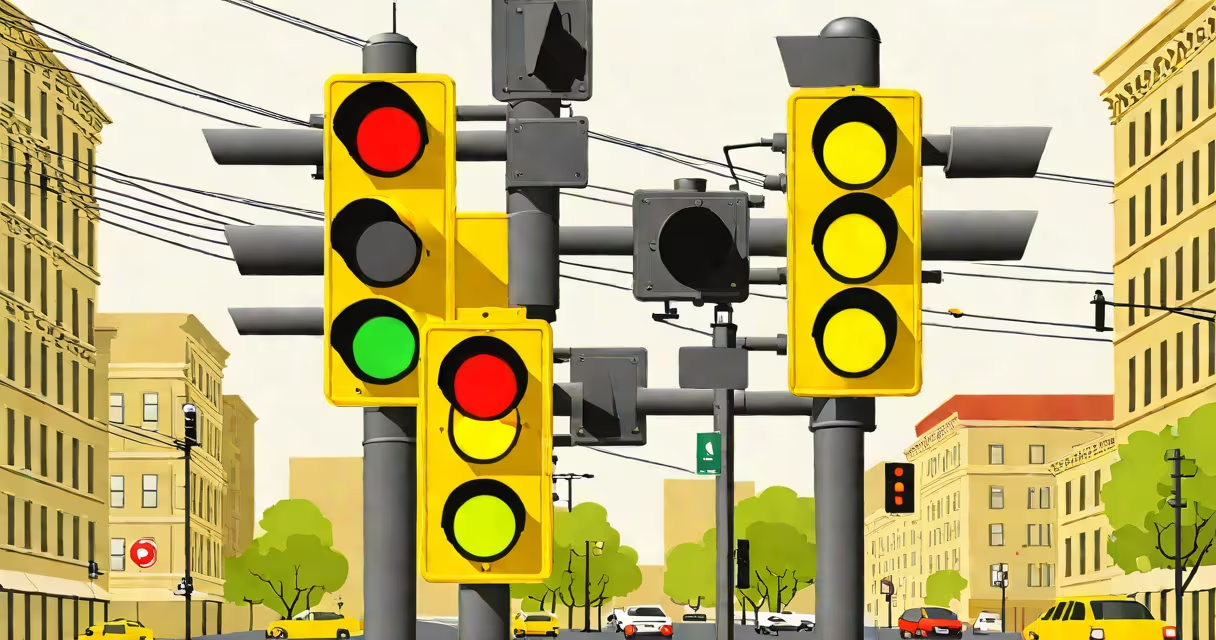
The yellow traffic light signals drivers to prepare to stop unless stopping would be unsafe. It indicates that the signal is about to turn red and warns of an upcoming change in traffic flow.
Yellow lights appear at intersections to give drivers time to react to a changing signal. They are part of a standardized system used across the United States and most of Europe. The National Highway Traffic Safety Administration (NHTSA) requires all traffic signals to follow specific timing protocols, including a minimum 3-second yellow phase at most urban intersections.
When the light turns yellow, drivers must decide whether they can stop safely. If stopping would cause a sudden brake or risk a collision, continuing through the intersection is permitted-but only if done cautiously. The key principle is safety, not speed.
After a green light, the signal transitions to yellow. This phase typically lasts between 3 and 6 seconds, depending on the posted speed limit. Higher-speed roads have longer yellow intervals to allow vehicles enough time to stop safely.
For example, on a road with a 45 mph speed limit, the yellow light duration is set to approximately 4.5 seconds. This accounts for average reaction time and braking distance. On a 30 mph street, the interval may be as short as 3 seconds.
If a driver enters the intersection during the yellow phase and the light turns red while they're still crossing, they are not automatically violating traffic law-provided they entered before the light changed. However, if they accelerate through the yellow to beat the red, they may face penalties.
Modern yellow traffic lights use high-intensity LEDs, which provide consistent brightness and reduce maintenance costs. Unlike older incandescent bulbs, LEDs consume less power and last longer-typically 50,000 hours or more.
Signals are controlled by timers or sensors embedded in the pavement. When a vehicle approaches, the sensor detects its presence and adjusts the timing based on traffic volume. In some cities, adaptive systems adjust yellow durations dynamically based on real-time traffic patterns.
For instance, in Los Angeles, traffic signals use a system called SCATS (Sydney Coordinated Adaptive Traffic System). It monitors vehicle flow and adjusts cycle lengths-including yellow durations-to minimize congestion and improve safety.
Many drivers think the yellow light means "go faster." That's incorrect. The purpose is not to encourage speed but to warn of an imminent change. Accelerating through a yellow light increases the risk of rear-end collisions and red-light violations.
A common error occurs when drivers wait too long to decide. Some hesitate until the light turns red, then panic-stop. This causes rear-end crashes. The NHTSA reports that nearly 10% of intersection crashes occur because drivers misjudge the yellow phase.
Another myth is that yellow lights are optional. They are not. In every U.S. state, failing to stop at a yellow light when safe to do so is a violation of traffic laws. In California, for example, Vehicle Code § 21453 states that drivers must stop at a yellow light unless doing so would create a hazard.
Consider a four-way intersection on a residential street with a 30 mph speed limit. The green light lasts 30 seconds. After that, the yellow light activates for 3.5 seconds. During this time, a car traveling at 28 mph approaches the crosswalk.
The driver sees the yellow light and checks their distance. They are 150 feet from the stop line. Braking at 10 ft/sec² (average deceleration), the car stops in about 120 feet. Since they are 150 feet away, they can stop safely.
They apply the brakes smoothly and come to a complete stop before the line. The light turns red. They remain stopped until the green light returns. This action complies with both safety standards and legal requirements.
If the same driver had been 80 feet from the stop line, they would have been too close to stop safely. In that case, continuing through the intersection at a reduced speed-without speeding-is legally acceptable and safer than slamming the brakes.
Understanding the difference between signal colors prevents confusion:
| Color | Meaning | Required Action | Duration (Typical) |
|---|---|---|---|
| Green | Proceed if safe | Continue through intersection | 20-45 sec |
| Yellow | Prepare to stop | Stop if safe; proceed cautiously if not | 3-6 sec |
| Red | Stop completely | Do not enter intersection | 20-60 sec |
Drivers often confuse yellow with a "caution" signal that allows them to continue at normal speed. But yellow is not caution-it's warning. It demands attention and decision-making.
I once drove through a yellow light in a rural area during heavy rain. I was approaching a stop sign at 35 mph. The light turned yellow, and I realized I couldn't stop safely. I continued through the intersection slowly, scanning for oncoming traffic. A car came from the left, but I had enough time to yield and avoid a crash.
That moment taught me that the yellow light isn't about rules-it's about judgment. It forces drivers to assess risk in real time. I now always check my distance and speed before reacting.
The yellow light is a model of clear communication in public infrastructure. Its design follows principles of human factors engineering. The color yellow is chosen because it stands out against natural backgrounds and is easily seen in low-light conditions.
According to the Federal Highway Administration (FHWA), yellow is the most visible color in daylight and performs well in fog. This makes it ideal for signaling change. The choice isn't arbitrary-it's based on decades of research into visual perception and driver behavior.
Even though the yellow light is simple, its impact is significant. It reduces accidents at intersections by giving drivers time to respond. Without it, collision rates would rise sharply.
What does the yellow traffic light mean? It means stop if safe. If stopping would cause danger, proceed with care. There is no exception for speed, no allowance for rushing through. The goal is safety-not timing.
Always remember: the yellow light is not a challenge. It's a warning. Treat it with respect, and you'll stay within the law and protect everyone on the road.