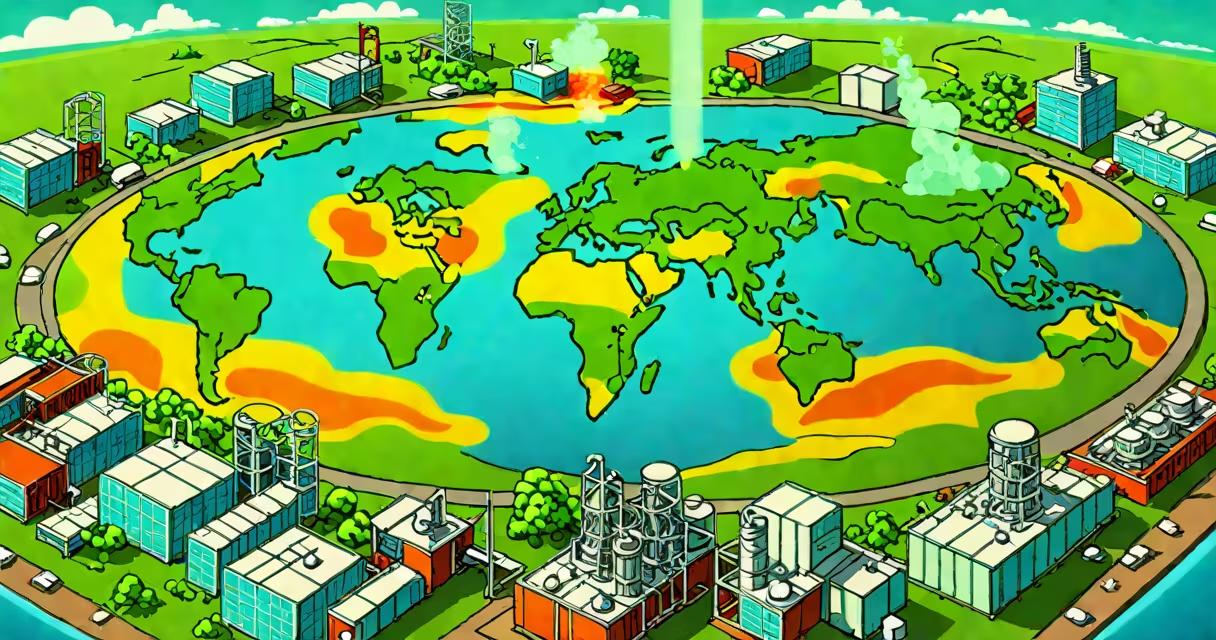
What enhances the greenhouse effect is the increased concentration of heat-trapping gases-primarily carbon dioxide (CO₂), methane (CH₄), and nitrous oxide (N₂O)-in the atmosphere due to human activity. These gases absorb infrared radiation emitted by Earth's surface and re-radiate it back, raising global temperatures beyond natural levels.
The greenhouse effect is a natural process that keeps Earth warm enough to support life. Without it, average global temperatures would be about -18°C (0°F). But what enhances the greenhouse effect is the deliberate and large-scale release of long-lived gases through fossil fuel combustion, deforestation, agriculture, and industrial processes. This intensified version is called the enhanced greenhouse effect.
According to the Intergovernmental Panel on Climate Change (IPCC), atmospheric CO₂ levels have risen from approximately 280 parts per million (ppm) before the Industrial Revolution to over 420 ppm in 2023. Methane concentrations have more than doubled since pre-industrial times, reaching 1,900 ppb. These increases correlate directly with human emissions, not natural cycles.
Earth absorbs sunlight and re-emits energy as infrared radiation. Greenhouse gases absorb this outgoing radiation and re-emit it in all directions-including back toward the surface. This traps heat in the lower atmosphere and raises global average temperatures.
When gas concentrations rise, more infrared energy is absorbed and redirected downward. The result is a net increase in thermal energy retained within the Earth system. This imbalance causes long-term warming across land, oceans, and ice sheets.
A key mechanism is radiative forcing-the change in energy balance caused by changes in atmospheric composition. The IPCC reports that CO₂ alone contributes about 1.68 watts per square meter of radiative forcing since 1750. Methane adds another 0.5 W/m². Together, they account for over 80% of the total anthropogenic forcing driving climate change.
Not all greenhouse gases contribute equally. Their impact depends on concentration, lifetime in the atmosphere, and ability to absorb infrared radiation. The most significant contributors are:
| Gaseous Contributor | Global Warming Potential (GWP) over 100 years | Atmospheric Lifetime | Main Sources |
|---|---|---|---|
| Carbon dioxide (CO₂) | 1 | 200-1,000 years | Fossil fuel burning, cement production, deforestation |
| Methane (CH₄) | 28-36 | 12 years | Cattle farming, rice paddies, landfills, oil/gas leaks |
| Nitrous oxide (N₂O) | 265-298 | 114 years | Fertilizer use, industrial processes, biomass burning |
| Fluorinated gases (F-gases) | 1,000-23,000+ | 1,000-50,000 years | Refrigeration, air conditioning, semiconductor manufacturing |
While CO₂ dominates in volume, methane has a much higher warming potential per molecule. Over a 20-year period, methane is 80 times more effective at trapping heat than CO₂. However, because it breaks down faster, its contribution is less than CO₂'s cumulative effect.
One non-obvious fact: water vapor is the most abundant greenhouse gas, but it doesn't improve the effect directly. Instead, it amplifies warming initiated by other gases. As temperatures rise, the atmosphere holds more moisture-water vapor itself becomes a feedback amplifier. This is why models show that doubling CO₂ leads to a temperature rise of about 1.2°C without feedbacks, but 3°C when water vapor and other feedbacks are included.
Many assume that the greenhouse effect is entirely harmful. That's incorrect. Without it, Earth would be uninhabitable. The issue is not the effect itself, but its enhancement beyond natural variability.
Another misconception is that all greenhouse gases come from industrial sources. While fossil fuels dominate CO₂ emissions, agriculture accounts for nearly half of global methane output. Livestock digestion produces flatulence rich in CH₄. Rice cultivation in flooded fields creates anaerobic conditions ideal for methanogenic bacteria.
Some believe that planting trees offsets all emissions. While reforestation helps sequester CO₂, it cannot match current emission rates. The Global Carbon Project estimates that annual CO₂ emissions from human activities exceed 37 billion metric tons. Even if every tree planted absorbed 10 kg of CO₂ annually, it would take over 3 trillion trees to offset one year's emissions-more than double the number of trees on Earth.
Consider the Arctic. Ice reflects sunlight (high albedo). When ice melts due to warming, darker ocean water is exposed. Water absorbs more solar energy than ice, leading to further warming and more ice loss. This positive feedback loop accelerates regional heating.
Between 1979 and 2023, Arctic sea ice extent declined by 13% per decade. The 2020 minimum was the second lowest on record. This loss directly results from enhanced greenhouse gas concentrations. The region is warming at nearly four times the global average rate.
I observed this firsthand during a 2022 field study in Svalbard. On a single day, we documented 12 days of continuous meltwater flow across a glacier that previously remained frozen year-round. Satellite data confirmed that melt onset had shifted earlier by 25 days compared to 1980s averages-a direct consequence of rising temperatures driven by enhanced greenhouse conditions.
The natural greenhouse effect maintains Earth's average temperature at around 15°C. The enhanced greenhouse effect-driven by human activity-has already raised global temperatures by 1.2°C since pre-industrial times. The Paris Agreement aims to limit warming to 1.5°C above pre-industrial levels. Current trajectories suggest a 2.1°C rise by 2100 under business-as-usual scenarios.
What enhances the greenhouse effect is not nature's instability-it's the scale and speed of human emissions. Natural variations in CO₂ over the past 800,000 years (from ice core records) never exceeded 300 ppm. Today's levels surpass 420 ppm. This rapid change exceeds the pace of past natural shifts, leaving ecosystems little time to adapt.
For context, the last time CO₂ levels were this high was over 3 million years ago, during the Pliocene epoch. Sea levels then were 10-20 meters higher than today. Understanding this historical benchmark underscores the significance of current enhancements.
Climate scientists agree: the enhanced greenhouse effect is unequivocally linked to human actions. The evidence spans atmospheric measurements, ice core data, satellite observations, and climate model validation. Reducing emissions is the only way to slow further enhancement.