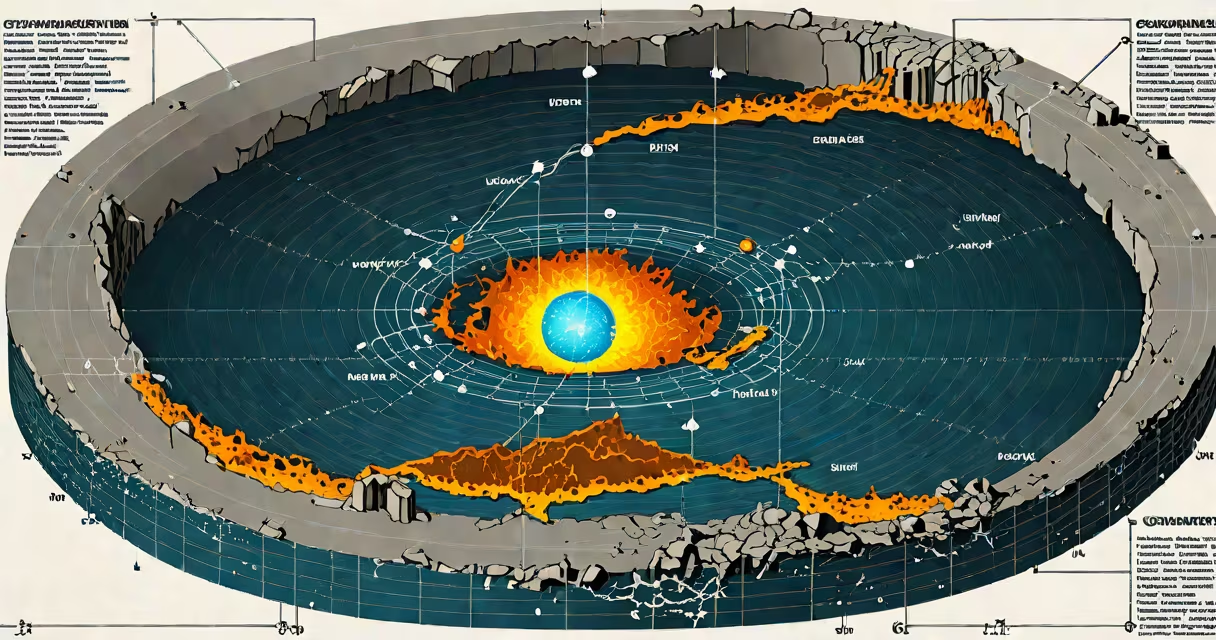
Geomagnetism is the scientific study of Earth's magnetic field, including its origin, structure, changes over time, and effects on the planet and its surroundings. The field arises from electric currents in Earth's molten outer core, driven by convection and planetary rotation.
The phenomenon is not static. Earth's magnetic field reverses polarity roughly every 200,000 to 300,000 years on average, though intervals vary widely. These reversals are recorded in volcanic rocks and seafloor sediments, providing a timeline of Earth's magnetic history.
Geomagnetism influences compass direction, guides animal migration, shields the surface from solar radiation, and affects satellite operations. It is distinct from atmospheric magnetism or human-made fields, which are much weaker and localized.
Earth's magnetic field originates in the outer core, a layer about 2,200 kilometers thick composed mostly of iron and nickel in a liquid state. Convection currents in this molten metal, combined with Earth's rotation, generate electric currents through the dynamo effect.
This process, known as the geodynamo, converts kinetic energy from fluid motion into magnetic energy. The resulting field extends thousands of kilometers into space, forming a protective bubble called the magnetosphere.
Measurements from satellites such as Swarm (launched by the European Space Agency in 2013) show that the field strength has declined by about 9% over the past 170 years. This trend suggests the field may be weakening ahead of a reversal, though such events take thousands of years to complete.
Scientists categorize geomagnetic features based on spatial scale and temporal behavior:
| Feature | Description | Duration | Source |
|---|---|---|---|
| Core Field | Main field generated by the geodynamo; accounts for ~95% of surface field | Millions of years | Outer core fluid dynamics |
| Crustal Field | Weak anomalies from magnetized rocks in Earth's crust | Millions of years | Volcanic and sedimentary rock magnetization |
| External Field | Varies with solar activity; caused by charged particles interacting with ionosphere | Minutes to days | Solar wind and magnetospheric currents |
Crustal fields are detectable via aeromagnetic surveys. For example, the Keweenaw Peninsula in Michigan shows strong anomalies due to ancient lava flows rich in magnetite. These anomalies help locate mineral deposits and map subsurface geology.
The magnetic poles do not align with the geographic poles. As of 2023, the North Magnetic Pole was located near Ellesmere Island in northern Canada, moving toward Siberia at about 55 km per year. This drift complicates navigation systems relying on magnetic declination.
Geomagnetism is often confused with gravity or climate patterns. It is not responsible for weather or seasonal shifts. The field does not cause tides, nor does it influence planetary orbits.
A common error is assuming magnetic reversals cause mass extinctions. While reversals coincide with some extinction events, no causal link has been proven. Fossil records show no consistent correlation between reversal timing and species die-offs.
Another misconception is that the magnetic field disappears during a reversal. Data from lava flows in Oregon and Idaho show that the field weakens but remains dipolar throughout the process. It doesn't vanish-it becomes complex and multipolar before re-establishing in the opposite orientation.
Animals such as migratory birds, sea turtles, and some insects use Earth's magnetic field for navigation. A 2018 study published in Nature Communications demonstrated that European robins orient using cryptochrome proteins in their eyes, which respond to magnetic fields via quantum effects.
In geology, paleomagnetism-the study of ancient magnetic fields preserved in rocks-allows scientists to reconstruct past continental positions. When basalt lava cools below the Curie temperature (~580°C for magnetite), magnetic minerals align with the local field, locking in direction and intensity.
For example, basalt flows in the Columbia River Basalt Group (USA) record a reversal event from 16 million years ago. By measuring the magnetic orientation of these rocks, researchers confirmed that North America had rotated since then.
I once observed a geomagnetic storm while working at a research station in Greenland. During a period of high solar activity, auroras lit up the sky in green and purple ribbons. The ground-based magnetometers recorded fluctuations exceeding 100 nanoteslas per minute-strong enough to disrupt power grid sensors and interfere with radio communications.
Geomagnetism protects life by deflecting harmful solar wind particles. Without it, Earth's atmosphere would erode over time, similar to Mars, which lost its global magnetic field billions of years ago.
Modern technologies depend on accurate models of the magnetic field. GPS systems correct for magnetic declination, especially in aviation and maritime navigation. Satellite operators monitor space weather to avoid damage from charged particles trapped in the Van Allen belts.
Understanding geomagnetism also helps predict long-term changes. The World Magnetic Model, maintained by the US National Centers for Environmental Information and the British Geological Survey, is updated every five years to ensure accuracy in navigation systems worldwide.
Geomagnetism is not just a curiosity-it is a fundamental force shaping Earth's environment, history, and technological infrastructure.
Geodynamo theory, supported by numerical simulations from the Nature journal, confirms that turbulent convection in the outer core sustains the field. Observations from the Swarm mission further validate these models by tracking field evolution in real time.
Earth's magnetic field is a changing system shaped by internal fluid motions. Its study reveals insights into planetary formation, habitability, and the long-term stability of our biosphere.
What is geomagnetism? It is the science of Earth's magnetic field-its origins, variations, and impacts. From guiding birds across continents to preserving evidence of past reversals in ancient rocks, it is a key thread in understanding our planet's deep past and ongoing evolution.