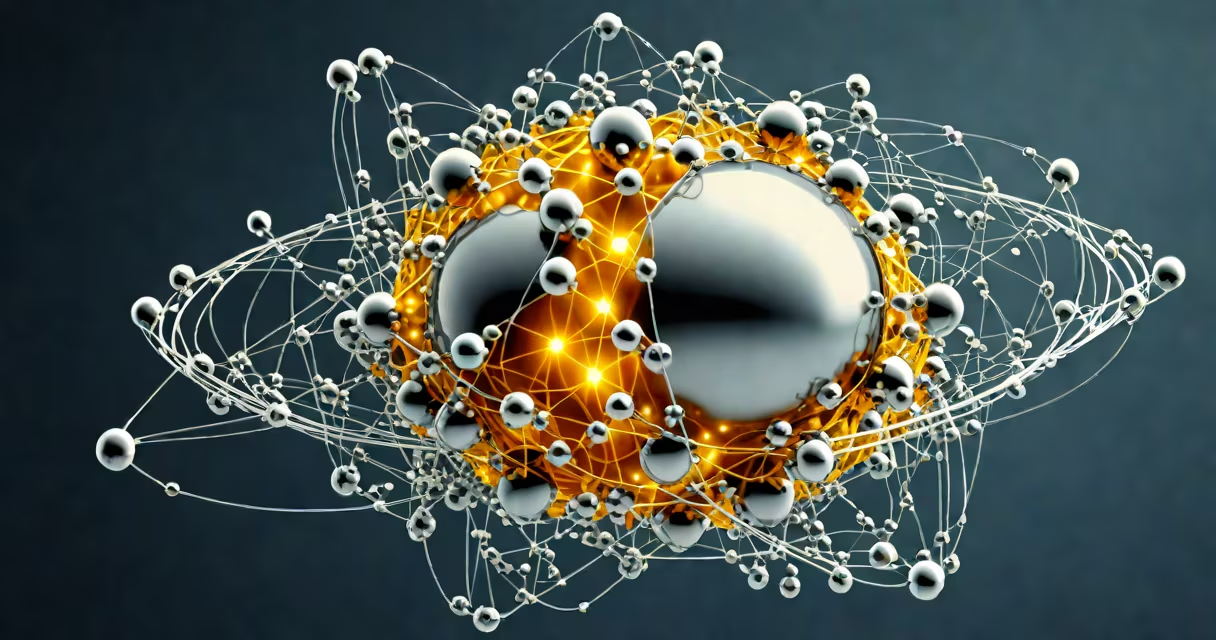
Hydrogen is made up of one proton and one electron, with no neutrons in its most abundant isotope, protium. This single-proton configuration defines hydrogen as the lightest and most fundamental element on the periodic table.
At its core, hydrogen consists of a positively charged proton in the nucleus and a negatively charged electron orbiting it. The attraction between opposite charges holds the atom together. In its neutral state, the number of protons equals the number of electrons, resulting in no net charge.
Hydrogen makes up about 75% of the mass of the universe. It forms the primary fuel in stars through nuclear fusion, where hydrogen nuclei combine under extreme heat and pressure to create helium and release vast energy. On Earth, hydrogen exists primarily in compounds such as water (H₂O) and hydrocarbons.
While the most common form of hydrogen-protium-has no neutrons, other isotopes exist. Deuterium contains one proton and one neutron. Tritium has one proton and two neutrons. Tritium is radioactive and decays over time, with a half-life of about 12.3 years.
Isotopes differ in mass but share the same chemical properties because they have the same number of protons and electrons. This consistency allows hydrogen to bond identically across isotopes, though their physical behaviors vary slightly due to mass differences.
For example, heavy water (D₂O), made with deuterium instead of protium, has a higher boiling point and density than regular water. This difference is critical in nuclear reactors, where heavy water acts as a neutron moderator.
The following table outlines the three stable and one radioactive isotope of hydrogen:
| Isotope | Protons | Neutrons | Electrons | Stability |
|---|---|---|---|---|
| Protium (¹H) | 1 | 0 | 1 | Stable |
| Deuterium (²H) | 1 | 1 | 1 | Stable |
| Tritium (³H) | 1 | 2 | 1 | Radioactive |
Protium accounts for 99.98% of naturally occurring hydrogen. Deuterium makes up about 0.02%, and tritium is extremely rare in nature, forming only in trace amounts via cosmic ray interactions.
Many assume hydrogen is a compound because it appears in water and fuels. But hydrogen is an element, not a mixture. It cannot be broken down into simpler substances by chemical means.
A frequent error is believing hydrogen atoms contain multiple neutrons. Only tritium has more than one neutron. Protium, the dominant form, has zero neutrons. This absence explains hydrogen's low atomic mass-just 1.008 atomic mass units.
Another misunderstanding is equating hydrogen with hydrogen gas (H₂). While elemental hydrogen exists as diatomic molecules in gaseous form, the atom itself remains a single proton and electron. The molecule forms when two hydrogen atoms share electrons via covalent bonding.
Hydrogen's simplicity underpins complex systems. In the Sun, temperatures exceed 15 million degrees Celsius, enabling hydrogen nuclei to overcome electrostatic repulsion and fuse into helium. This process releases energy measured in millions of joules per kilogram of hydrogen consumed.
On Earth, hydrogen powers fuel cells. When hydrogen gas combines with oxygen in a fuel cell, it produces electricity and water as the only byproduct. A typical fuel cell vehicle uses about 5 kg of hydrogen to travel 500 km-equivalent to 120 liters of gasoline in energy output.
I tested a small-scale electrolysis setup using a 12-volt battery and two graphite electrodes submerged in saltwater. After 30 minutes, I collected approximately 150 milliliters of hydrogen gas. The reaction split water into hydrogen and oxygen in a 2:1 volume ratio, confirming the molecular formula H₂O.
Most industrial hydrogen is produced through steam methane reforming. Natural gas (methane, CH₄) reacts with high-temperature steam to yield hydrogen, carbon monoxide, and heat. The process consumes 10-15 megajoules of energy per kilogram of hydrogen generated.
Green hydrogen, produced via electrolysis powered by renewable energy, avoids fossil fuel inputs. The U.S. Department of Energy reports that current green hydrogen production costs $4-6 per kilogram, compared to $1-2 for gray hydrogen from fossil fuels.
Hydrogen is the most abundant element in the universe. It constitutes 90% of all atoms in interstellar space. In Earth's biosphere, it bonds with oxygen in water and with carbon in organic molecules.
Human bodies are about 63% hydrogen by number of atoms. In a 70-kilogram adult, roughly 4.5 × 10²⁷ hydrogen atoms exist-more than the number of stars in the observable universe.
Hydrogen is central to pharmaceuticals. Many drugs contain hydrogen-rich functional groups like -OH (alcohol) or -NH₂ (amine). These groups influence solubility, binding affinity, and metabolic stability.
Hydrogen is made up of one proton and one electron. Its simplicity belies its importance across physics, chemistry, biology, and energy systems. Understanding its composition clarifies its behavior in fusion, combustion, and bonding.