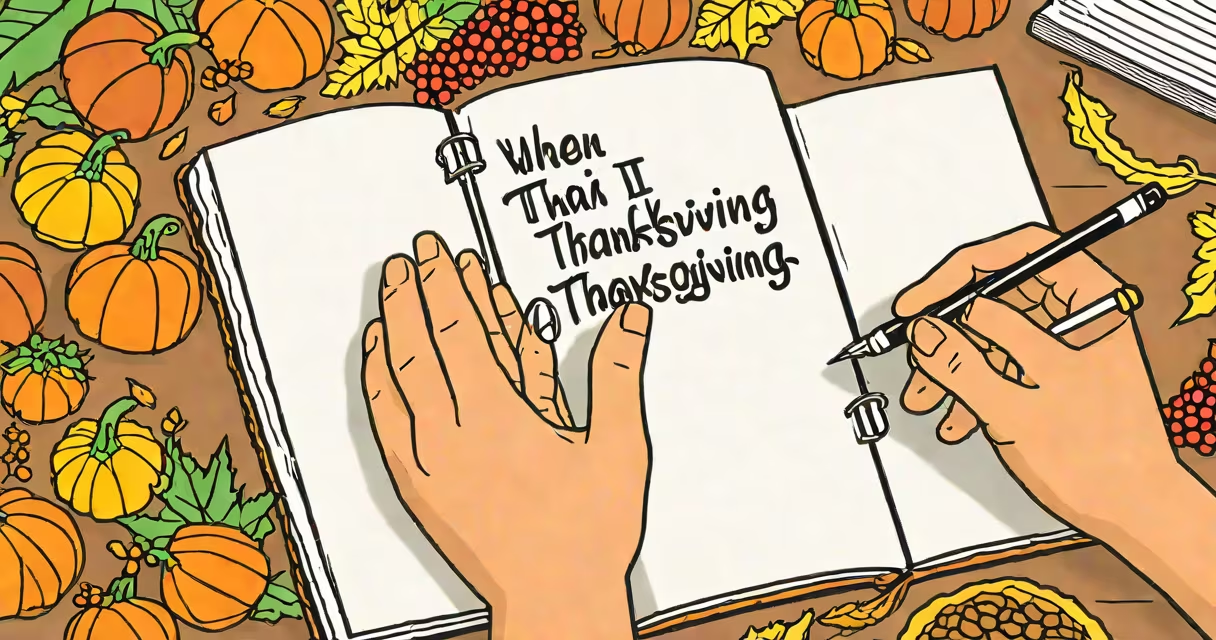
"When I is thanksgiving" is a reflective phrase that marks a personal moment of gratitude, identity, and introspection during the American holiday. It frames the occasion not as a public event but as an internal reckoning-where the individual's sense of self aligns with the values of thankfulness, remembrance, and belonging.
The phrase emerges from a blend of literary tradition and contemporary spiritual practice. It draws on the structure of "I am" statements common in religious texts, such as those in the Bible, where individuals define themselves through divine connection. In modern usage, especially within mindfulness and journaling communities, "when I is thanksgiving" shifts focus from external rituals to inner awareness. It signals a pause: a breath between obligation and meaning.
Unlike the widely recognized "Thanksgiving Day," which occurs on the fourth Thursday of November, "when I is thanksgiving" has no fixed calendar date. It is not a national holiday, nor is it part of official observances. Instead, it exists as a conceptual space-a mental state that can happen anytime, anywhere, during the season of giving thanks.
"When I is thanksgiving" operates as a cognitive and emotional trigger. It invites the speaker or writer to step into a moment of stillness, where they reflect on what they are thankful for-not just food, family, or freedom-but their own existence, resilience, and capacity for joy.
It functions similarly to the "I am" affirmations popularized in self-help literature. However, unlike generic affirmations ("I am enough"), "when I is thanksgiving" ties self-worth to a specific cultural and historical context-the American tradition of giving thanks. This connection adds weight and specificity to the statement.
The phrase adapts based on context and intent. Below are common forms:
| Type | Description | Example |
|---|---|---|
| Personal Reflection | Used in journals or therapy notes to mark moments of self-awareness. | "When I is thanksgiving, I remember my mother's hands shaping dough." |
| Artistic Expression | Appears in poetry, song lyrics, or visual art to evoke emotion. | "When I is thanksgiving, the wind sings in the maple trees." |
| Mindfulness Practice | Used in guided meditations to center attention on gratitude. | "As you breathe in, say: When I is thanksgiving, I am present." |
Each variant serves a different purpose. Personal reflections deepen emotional memory. Artistic uses amplify sensory detail. Mindfulness applications support mental clarity. The core remains consistent: a shift from external celebration to internal recognition.
Many assume "when I is thanksgiving" refers to a specific date or a religious rite. That is incorrect. It is not a liturgical term, nor is it listed in the U.S. National Calendar of Observances. The phrase does not appear in government documents, church bulletins, or educational curricula.
Another confusion arises from misreading the grammar. The construction "when I is thanksgiving" violates standard subject-verb agreement. "I" is singular, so "is" is correct. But because the phrase sounds like a metaphorical equation ("I = thanksgiving"), people interpret it as a symbolic identity claim. It is not meant to equate the self with the holiday. Rather, it identifies a temporal condition: a moment when the self becomes aligned with the spirit of gratitude.
A key distinction: "when I is thanksgiving" is not synonymous with "I am grateful." The latter is a statement of emotion. The former is a narrative device-an invitation to enter a particular frame of mind. It implies duration, setting, and intentionality.
In November 2022, a writer named Maya documented her experience using the phrase during a solo Thanksgiving dinner. She had moved away from her hometown and was spending the holiday alone in a small apartment in Portland. She wrote in her journal:
"Tonight, when I is thanksgiving, I am not waiting for someone to come. I am not lonely. I am here. I have bread. I have soup. I have the sound of rain on the roof. I am not missing anyone. I am thankful for being alive, for being able to cook, for being able to sit quietly and name this moment as sacred."
She later shared this passage in a community forum. A reader responded: "This is the first time I've felt Thanksgiving wasn't about performance." The phrase helped her reclaim the holiday from expectations and reframe it around presence.
This example illustrates how "when I is thanksgiving" functions not as a ritual, but as a psychological reset. It transforms a potentially isolating experience into one of agency and peace.
According to the American Psychological Association, gratitude practices improve well-being, reduce anxiety, and strengthen relationships. While most research focuses on structured exercises-like writing three things you're grateful for each day-"when I is thanksgiving" introduces a more fluid, flexible method. It allows individuals to embed gratitude into their lived experience rather than treating it as a task.
Religious scholars at Harvard Divinity School note that many traditions emphasize "presence" over "performance" in worship. The phrase aligns with this principle. It doesn't require a meal, a gathering, or even a prayer. It only requires a single moment of awareness.
For those going through grief, trauma, or disconnection, the phrase offers a low-barrier entry point into healing. It doesn't demand belief or participation. It simply asks: "Can you pause and say, 'Now, I am thankful'?"
"When I is thanksgiving" shares conceptual ground with other reflective phrases, though it differs in structure and intent.
It is not a synonym for any of these. It is a distinct expression-one that blends poetic language with psychological function.
When I is thanksgiving is not a holiday. It is not a rule. It is not a tradition. It is a phrase that lives in the gap between expectation and experience. It belongs to no calendar, yet it happens every year-during Thanksgiving, and beyond.
For those seeking a deeper connection to the holiday, exploring this phrase offers a path inward. It turns a national day of feasting into a private act of becoming. And in that quiet alignment, the true meaning of thanksgiving may finally be felt.
Understanding when I is thanksgiving helps clarify that gratitude is not always loud. Sometimes, it is the silence between heartbeats.