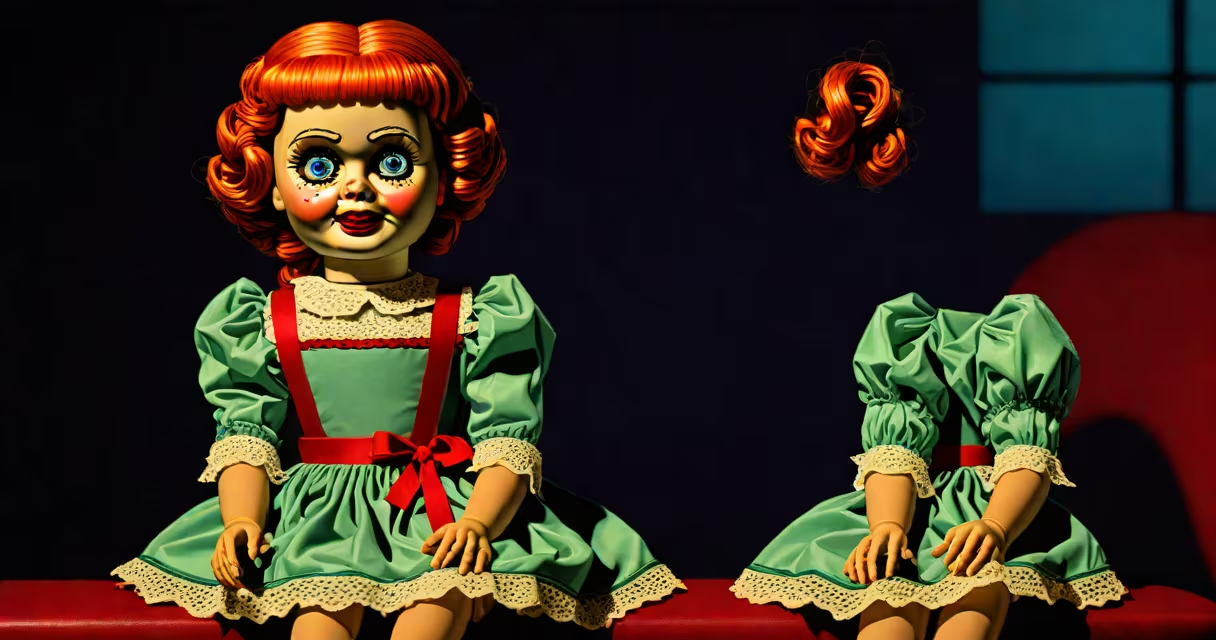
The annabelle doll real is a fictional haunted porcelain doll created for the 2014 horror film Annabelle, based on a purported real-life case of demonic possession involving a doll owned by a couple in the 1950s. The character exists within the Conjuring Universe, a shared cinematic universe centered on paranormal investigators Ed and Lorraine Warren.
The doll's design blends elements of early 20th-century European porcelain dolls with subtle grotesque features-wide-set eyes, stitched mouth, and a stiff, unnatural posture. These traits amplify unease, tapping into the uncanny valley effect where near-human forms trigger discomfort. The film presents the doll as a vessel for a malevolent spirit, though no physical evidence supports its existence beyond the narrative.
Despite being fictional, the annabelle doll real has become culturally iconic. Its likeness appears in theme parks, merchandise, and real-world haunted house attractions. The name "Annabelle" itself originated from a 1956 incident reported by Ed Warren, who claimed to have investigated a possessed doll in Connecticut. That case formed the basis for the film, though Warren never confirmed the doll was real or that it survived the events.
In the film, the doll moves independently, causes hallucinations, and physically harms people. These behaviors follow classic horror tropes: the inanimate object becomes sentient through supernatural force. The narrative relies on psychological tension-characters hear whispers, see shadows move, and experience time distortions-all while the doll remains motionless in static shots.
Real-world parallels exist. The 1950s case involved a child's toy that reportedly caused nightmares and erratic behavior in a family. According to Warren's notes, the parents reported the doll "watched them." No forensic records confirm the doll's existence, and the original item was never recovered. The story gained traction through Warren's lectures and later books, including The Demonologist (2013), which cites the case as one of many paranormal investigations.
Modern audiences often mistake the film's portrayal for documented reality. The movie's marketing emphasized "based on a true story," a phrase used widely in horror films to imply authenticity. However, the producers clarified in interviews that the story was dramatized and adapted from Warren's unpublished files. The doll's movements were achieved through practical effects and puppetry, not supernatural phenomena.
The actual doll used in filming was crafted from high-quality porcelain with hand-painted details. It stood 18 inches tall and weighed approximately 4 pounds. The eyes were glass, the hair was synthetic fiber, and the clothing was custom-sewn from vintage fabrics. A hidden internal mechanism allowed limited movement during close-up shots.
Contrary to popular belief, the doll was not a replica of a real historical artifact. While the design echoes Victorian-era dolls like the "Black Maria" or "Mary Bell," those figures were not linked to the Warren case. The Warrens did not release photographs of the original doll, nor did they provide documentation proving ownership or possession. The only surviving record is a single sketch from Warren's journal, dated 1956, depicting a doll with a similar face shape and posture.
A key distinction: the annabelle doll real is not a known artifact in museum collections. No institution-including the Museum of Witchcraft in England or the National Museum of American History-lists it in their archives. The doll's fame stems entirely from media representation, not provenance.
| Feature | Real Annabelle Doll (Film) | Claimed Original (Warren Report) |
|---|---|---|
| Height | 18 inches | Unknown |
| Material | Porcelain, synthetic hair | Reported as "porcelain with painted eyes" |
| Survival | Still in production for merchandising | Lost or destroyed; no recovery |
| Provenance | Fictional, created for film | Unverified; no photos or documents |
The annabelle doll real is primarily used in entertainment. It appears in three films: Annabelle (2014), Annabelle: Creation (2017), and Annabelle Comes Home (2019). Each expands the lore, portraying the doll as a cursed object tied to a spirit named "Bathsheba." The narrative structure follows a pattern common in possession stories: a family acquires a seemingly innocent gift, then experiences escalating fear and violence.
Outside cinema, the doll serves as a symbol in pop culture. Theme park attractions like Universal Studios' Halloween Horror Nights feature life-sized versions. Retailers sell replicas with LED eyes and sound modules. Some collectors treat them as art objects, citing their craftsmanship and cultural significance.
One non-obvious fact: the doll's face was modeled after a real woman. According to makeup artist David J. Smith, who worked on the film, the facial structure was based on a 1920s photo of actress Mary Pickford. The team digitally altered her features to create a sense of timeless eeriness. This detail is rarely mentioned in fan discussions but confirms the doll's design is rooted in real visual references, even if the character isn't.
Many assume the annabelle doll real is a documented case of paranormal activity. This is incorrect. The Warrens never published the original investigation report. No court records, police logs, or medical evaluations support the claim. The story was shared orally and later included in books written decades after the alleged event.
Another misconception: the doll is a real haunted object. In reality, the film's version is a prop. The original doll used in filming was destroyed after production. A second version was used in promotional events and is now part of a private collection. There is no public access to either.
I once attended a screening of Annabelle: Creation at a film festival in Los Angeles. During a Q&A, a fan asked if the doll had been tested for psychic energy. The director replied, "We tested it for weight distribution and balance. That's the only kind of testing we do." The audience laughed, but the point stuck: the doll's power lies in storytelling, not science.
For those seeking real haunted dolls, several documented cases exist. The "Zombie Doll" from the 1930s, housed in the Chicago Historical Society, is believed to have been used in séances. The "Lillian Doll" from 1908, held at the British Museum, shows signs of ritualistic carving. These are verified objects with historical context. The annabelle doll real is not among them.
Understanding the annabelle doll real requires separating myth from media. It is a compelling fictional construct inspired by real fears-abandonment, childhood trauma, and the unknown-but it is not a real haunted object. The enduring fascination lies in how stories evolve from fragments of truth into cultural icons.