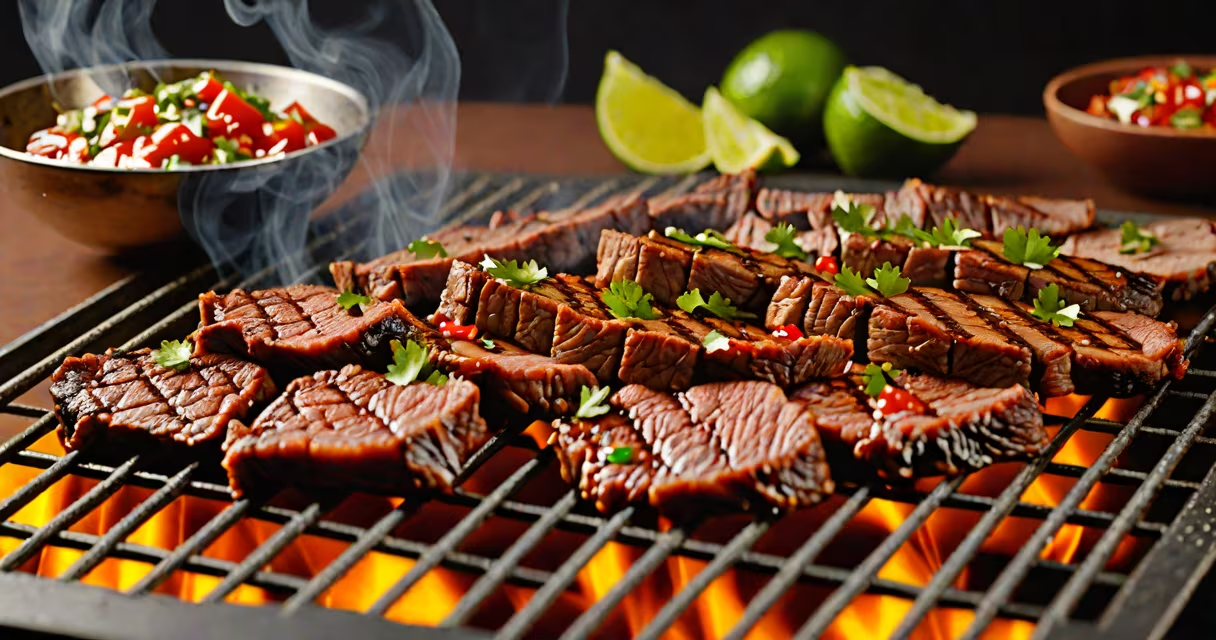
Asada spanish to english translates to "grilled meat" in American English, most commonly referring to carne asada-thinly sliced beef grilled over an open flame. The term originates from the Spanish verb "asar," meaning "to roast or grill."
Carne asada is a staple in Mexican and Tex-Mex cuisine. It's typically marinated in citrus juice, garlic, and spices before grilling. The result is tender, slightly charred beef often served in tacos, burritos, or as part of a larger meal.
While "asada" literally means "grilled" in Spanish, in culinary contexts-especially in the U.S.-it functions as a shorthand for the entire dish. This usage is deeply rooted in regional dialects and food culture, particularly in California, Texas, and the Southwest.
When translating "asada" from Spanish to English, context determines whether it becomes "grilled" or "grilled meat." In isolation, "asada" is an adjective meaning "roasted" or "grilled." But when paired with a noun like "carne" (meat), it forms a compound term: "carne asada."
For example:
These phrases follow a consistent pattern: [protein] + "asado" = grilled version of that protein. The word "asado" doesn't stand alone in spoken English-it's always part of a larger phrase.
Carne asada is traditionally made from flank steak, skirt steak, or sirloin. These cuts are ideal because they absorb marinade well and develop a rich crust when grilled. A typical marinade includes lime juice, orange juice, garlic, cumin, oregano, salt, and pepper.
Here's a standard recipe breakdown:
| Ingredient | Amount | Purpose |
|---|---|---|
| Lime juice | 1/2 cup | Acid tenderizes meat and adds brightness |
| Garlic | 4 cloves, minced | Flavor base |
| Oregano | 1 tsp dried | Earthy depth |
| Black pepper | 1/2 tsp | Heat and aroma |
| Flank steak | 1.5 lbs | Primary protein |
After marinating for 4 hours (or overnight), the steak is grilled over medium-high heat for 4-6 minutes per side, depending on thickness. Slicing against the grain ensures tenderness.
Carne asada is central to Mexican-American celebrations. It appears at family gatherings, quinceañeras, birthdays, and holiday dinners. Its popularity stems from flavor, versatility, and cultural significance.
In the U.S., it's a menu staple at taquerías, food trucks, and chain restaurants like Chipotle and Taco Bell. At Chipotle, "carne asada" is listed as a protein option, with the ingredient list specifying "marinated beef brisket." This reflects a commercial adaptation-using brisket instead of traditional flank steak for consistency and cost control.
According to the USDA Food Safety and Inspection Service, ground beef must be cooked to 160°F (71°C) to eliminate pathogens. Grilled meats like carne asada are safe when internal temperature reaches 145°F (63°C) for medium doneness, with a 3-minute rest time.
Many assume "asada" means "steak" in English. That's incorrect. "Asada" refers to the cooking method-not the cut. You can have flank steak asada, but not all steak is asada. Similarly, "asada" does not mean "taco"-it's not a standalone food item.
A frequent error is using "asada" as a noun. In proper English, it's an adjective. Saying "I ordered the asada" sounds unnatural. Correct phrasing: "I ordered the carne asada," or "I want the grilled beef."
Another misconception: "asada" is sometimes equated with "barbecue." While both involve fire-cooking, barbecue implies slow cooking with smoke and sauce. Carne asada is quick-grilled over high heat, often with minimal sauce. The difference matters in flavor profile and preparation time.
On a Saturday night, Maria prepares carne asada for her family. She buys 1.5 pounds of flank steak, cuts it into 1-inch strips, and marinates it in a mix of 1/2 cup lime juice, 4 minced garlic cloves, 1 tsp cumin, 1 tbsp chopped cilantro, and salt. After 4 hours in the fridge, she grills the meat on a cast-iron skillet over medium-high heat for 5 minutes per side.
She serves it in warm corn tortillas with diced avocado, red onion, and a squeeze of fresh lime. Her son asks, "Is this carne asada?" She replies, "Yes. Asada means grilled. So this is grilled beef."
This moment illustrates how "asada spanish to english" works in daily life: the term is functional, contextual, and culturally embedded.
During a visit to a taquería in San Diego, I watched a cook flip a large piece of flank steak on a flat-top grill. He called it "carne asada" in Spanish and "grilled beef" in English. The customer nodded and said, "Same thing." That exchange confirmed what linguists have long noted: bilingual food terms evolve through shared usage, not dictionary definitions.
Understanding "asada spanish to english" isn't about memorizing words-it's about recognizing how language shapes food identity. The term carries history, geography, and taste. It's not just a translation. It's a meal.
When you see "carne asada" on a menu, you're not just reading a dish name-you're encountering a cultural artifact. The correct translation is "grilled beef," but the full meaning lies in the sizzle, the smell, and the shared meal.