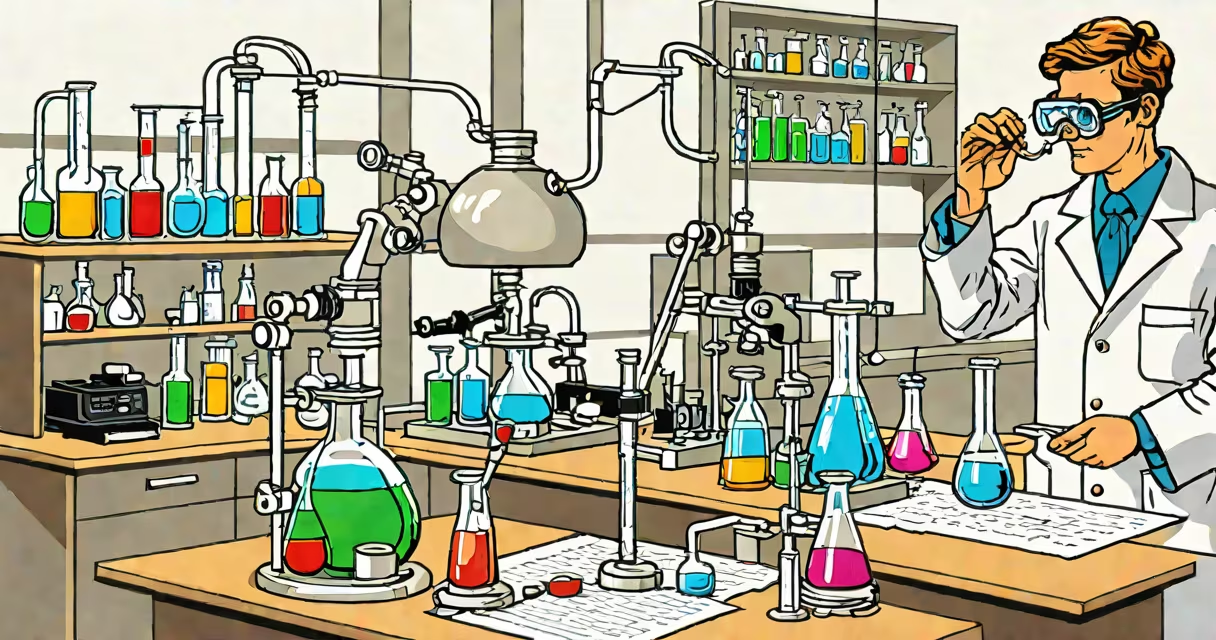
Chemistry major requirements are the structured set of courses, labs, and credit hours that undergraduates must complete to earn a bachelor's degree in chemistry, typically a Bachelor of Science (B.S.) degree. These include foundational science courses, advanced theory and laboratory work, and mathematics prerequisites. The goal is to build a rigorous understanding of atomic structure, chemical reactions, thermodynamics, and molecular behavior.
Most chemistry programs require students to take four core areas: general chemistry, organic chemistry, physical chemistry, and analytical chemistry. Each course includes both lecture and hands-on lab components. Students usually begin with introductory courses in their first year, then progress to upper-level electives such as biochemistry, quantum chemistry, or materials science. A minimum of 120 credit hours is typical, though some schools require 126-130.
Core requirements often include calculus through multivariable, physics with mechanics and electromagnetism, and sometimes computer programming. Institutions like MIT and Caltech expect students to complete research projects or independent study during their junior or senior year. The American Chemical Society (ACS) certifies degrees that meet specific standards, including 36 credits in chemistry and 12 in related sciences.
Undergraduate chemistry majors follow a sequence designed to build knowledge progressively. First-year students take general chemistry I and II, which cover stoichiometry, bonding, thermodynamics, and reaction kinetics. These courses are typically paired with lab sections that teach pipetting, titrations, spectroscopy, and error analysis.
In the sophomore year, students move into organic chemistry, focusing on carbon-based compounds, reaction mechanisms, and synthesis. This phase emphasizes visualization of molecular geometry and stereochemistry. Physical chemistry introduces quantum mechanics, statistical thermodynamics, and rate laws, often using mathematical models to predict molecular behavior.
By junior year, students take analytical chemistry, learning instrumental techniques like UV-Vis spectrophotometry, gas chromatography, and mass spectrometry. Lab time increases -many programs require 6-8 hours per week in the lab. Senior year involves capstone projects, research, or advanced electives such as polymer chemistry or environmental toxicology.
While most U.S. colleges offer a B.S. in chemistry, some provide a B.A. for students interested in interdisciplinary paths. The B.S. demands more science and math credits, making it ideal for graduate school or industry careers. The B.A. allows flexibility, often requiring fewer math and physics courses.
| Degree Type | Typical Credit Hours | Math & Physics Requirements | Lab Hours | Best For |
|---|---|---|---|---|
| B.S. in Chemistry | 120-130 | Calculus I-III, Differential Equations, Physics I-II | 10-15 hrs/week | Graduate school, pharmaceuticals, research |
| B.A. in Chemistry | 120 | Calculus I-II, Physics I | 6-8 hrs/week | Education, law, business with science focus |
Some universities offer specialized tracks within the major. For example, the University of Michigan offers a "Chemistry and Materials Science" track that includes courses in solid-state chemistry and nanomaterials. Others, like Stanford, allow students to double major in chemistry and engineering, integrating coursework in thermodynamics and fluid dynamics.
Many assume that chemistry majors spend most of their time memorizing formulas. In reality, the focus is on problem-solving, experimental design, and critical thinking. A 2022 report from the National Science Foundation found that 78% of chemistry graduates reported using quantitative reasoning daily in their jobs, compared to 45% in non-STEM fields.
Another misconception is that all chemistry majors go to medical school. While some do, the majority pursue careers in industry, government, or academia. According to the ACS, about 55% of chemistry B.S. recipients enter the workforce directly after graduation, with roles in quality control, product development, or regulatory affairs.
A key distinction is between chemistry and biochemistry majors. Biochemistry requires additional biology and genetics coursework. A student pursuing a biochemistry major may take 18 credits in biology, while a pure chemistry major focuses on physical and inorganic systems. The difference matters for career paths: biochemists often work in drug discovery, while chemists in materials science develop new polymers or catalysts.
Consider Maya, a freshman at the University of California, San Diego. Her chemistry major requires 130 credit hours. She begins with CHEM 1A (General Chemistry), MATH 150A (Calculus I), and PHYS 1A (Physics for Scientists). Each course includes a 3-hour lecture and a 3-hour lab.
In her sophomore year, she takes CHEM 110 (Organic Chemistry I), CHEM 111 (Organic Chemistry II), and PHYS 1B (Electricity and Magnetism). She spends 12 hours weekly in the lab, synthesizing aspirin and analyzing purity via IR spectroscopy. By junior year, she enrolls in CHEM 120 (Physical Chemistry I), where she solves Schrödinger equations and models reaction rates using differential equations.
Her senior year includes a research project under Dr. Lin, studying catalytic degradation of microplastics. She presents findings at the ACS National Meeting. She completes 300 lab hours, 18 credits in advanced chemistry, and a 6-credit capstone seminar. She graduates with honors and secures a job at a renewable energy startup developing battery electrolytes.
One non-obvious requirement is proficiency in scientific communication. Many programs now require students to write formal lab reports, present data in posters, and defend methods orally. At the University of Wisconsin-Madison, students must pass a written exam on lab safety and ethics before beginning advanced labs.
Another overlooked element is departmental advising. Students who skip mandatory advising sessions risk taking incorrect course sequences. For example, skipping MATH 221 (Multivariable Calculus) can delay enrollment in physical chemistry, pushing graduation back by a semester. The National Association of Advisors for the Sciences (NAAS) reports that 34% of chemistry students who delayed graduation cited poor academic planning.
When comparing majors, students often confuse chemistry with geology or political science. Geology majors focus on Earth processes, minerals, and fieldwork, requiring courses in sedimentology and structural geology. Political science majors study governance, policy, and international relations, with heavy reading and writing loads. A student choosing between them should consider whether they prefer working with molecules or analyzing social systems.
Chemistry major requirements are not just a checklist-they form a scaffold for scientific reasoning, experimentation, and innovation. Success hinges on consistent engagement with theory, practice, and critical evaluation. Completing these requirements prepares students for diverse roles in medicine, energy, environmental science, and beyond.