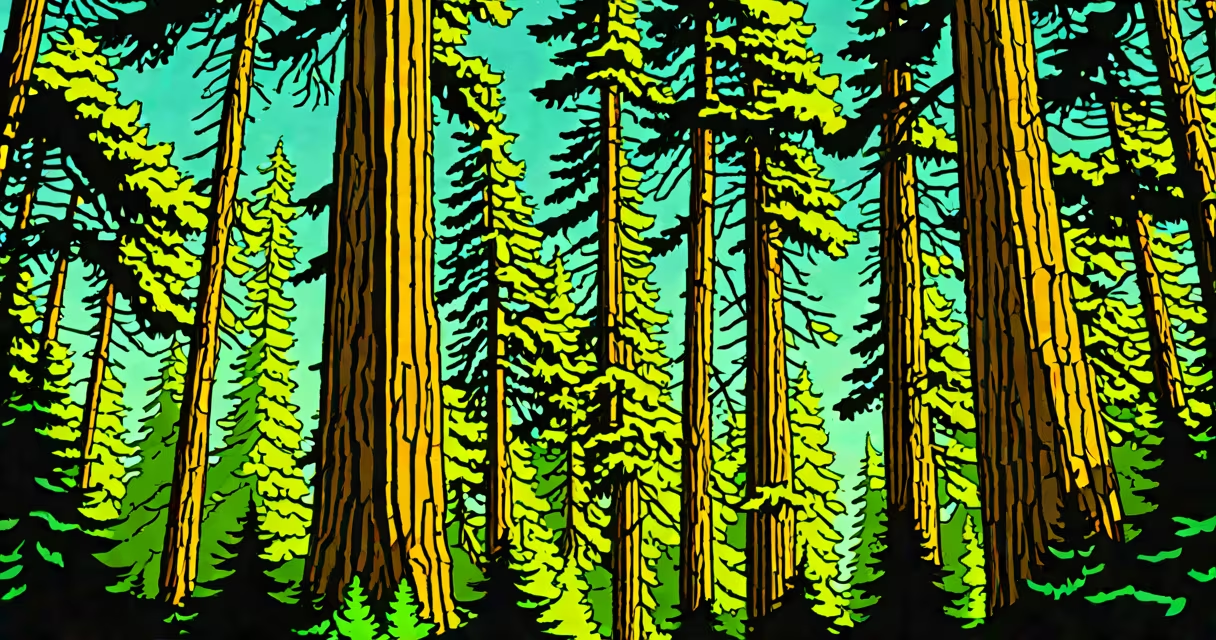
The coast redwood (Sequoia sempervirens) is the tallest tree species on Earth, reaching heights exceeding 380 feet and living for over 2,000 years. Native to the fog-drenched forests of coastal Northern California and southern Oregon, it thrives in a narrow strip of land just inland from the Pacific Ocean.
These trees grow in dense stands where their roots interlock underground, forming a network that stabilizes soil and shares nutrients. Their thick, fibrous bark-up to 12 inches deep-resists fire and decay, allowing them to survive disturbances that kill other species. A single mature redwood can store more carbon than 10,000 average-sized trees.
Redwoods reproduce via seeds and sprouts. Seeds are tiny-about 1/16 inch long-and require bare mineral soil to germinate. Most new trees emerge from root sprouts, which can regenerate decades after the parent tree dies. This clonal growth allows entire groves to persist for millennia.
Coast redwoods rely on a combination of fog drip, deep groundwater, and efficient water transport systems. Their needle-like leaves absorb moisture directly from fog during summer months when rainfall is scarce. This adaptation enables survival in regions with dry summers.
Water moves upward through xylem vessels using capillary action and transpiration pull. Despite their height, redwoods maintain consistent water pressure throughout the crown. Studies show that water reaches the top of a 380-foot tree in under 30 minutes, driven by evaporation from leaves.
Roots spread widely-up to 100 feet-but rarely penetrate deeper than 10 feet. The shallow root system relies on interconnected networks between adjacent trees. When one tree falls, neighboring individuals often survive due to shared root connections, maintaining forest stability.
While all coast redwoods belong to the same species, variation exists based on location and age. Young trees have thin, reddish-brown bark that darkens with time. Mature specimens develop deeply furrowed, spongy bark resistant to fire and insect damage.
| Feature | Details |
|---|---|
| Maximum height | 380 feet (116 meters) |
| Oldest known individual | 2,200 years old (in Redwood National Park) |
| Bark thickness | Up to 12 inches (30 cm) |
| Fog interception rate | Up to 40% of annual moisture input |
| Seed viability | Under 10% germination success in natural conditions |
Redwoods do not form rings in the traditional sense. Instead, they produce annual growth layers visible only under microscopic analysis. This makes dendrochronology difficult, requiring specialized techniques to date older specimens accurately.
Coast redwood forests cover less than 1% of California's original forest area due to logging. Historically, timber was harvested for construction, railway ties, and telephone poles. Today, protected areas like Redwood National and State Parks preserve remaining ancient groves.
These forests support rare wildlife. The marbled murrelet-a seabird-nests exclusively in the high canopy of old-growth redwoods. Its population declined by 70% since the 1970s due to habitat loss. Conservation efforts now focus on restoring nesting sites and limiting human disturbance.
Redwoods also serve as climate regulators. A single hectare of old-growth redwood forest sequesters 2,500 tons of carbon dioxide-equivalent to removing 500 cars from the road annually. Scientists estimate that preserving existing redwood ecosystems could offset 10% of California's annual emissions.
Many assume redwoods are the longest-living trees. While they live over 2,000 years, the Great Basin bristlecone pine (Pinus longaeva) holds the record at 5,000+ years. Redwoods are not the most massive trees either-the giant sequoia (Sequoiadendron giganteum) exceeds them in volume.
Another myth is that redwoods grow faster than other trees. They do not. Coast redwoods grow about 1 foot per year during peak growth periods. That's slower than many hardwoods like maple or oak. Their longevity stems from resilience, not speed.
A lesser-known fact: redwood roots cannot tolerate standing water. Unlike some wetland trees, they die quickly if submerged. This limits their distribution to well-drained slopes and river terraces. Soil saturation causes root rot within days.
In 1931, a redwood named the Founders Tree stood in the heart of a grove near Avenue of the Giants in Humboldt County. Measuring 350 feet tall and 30 feet in diameter, it was one of the tallest documented trees. After a storm in 1934, it fell during a wind event. Its stump remains preserved as a monument.
Scientists later analyzed its rings using radiocarbon dating. The tree began growing around 140 CE, placing its origin in the late Roman Empire. It survived droughts, fires, and storms for nearly 1,900 years-longer than any living human has existed.
I once stood beneath a fallen redwood in Muir Woods during a winter rainstorm. The trunk was split open, revealing concentric rings that spanned centuries. Water dripped from the canopy above, hitting the ground with a soft drumming sound. The air smelled of damp earth and resin. In that moment, I understood scale-not just physical size, but time itself.