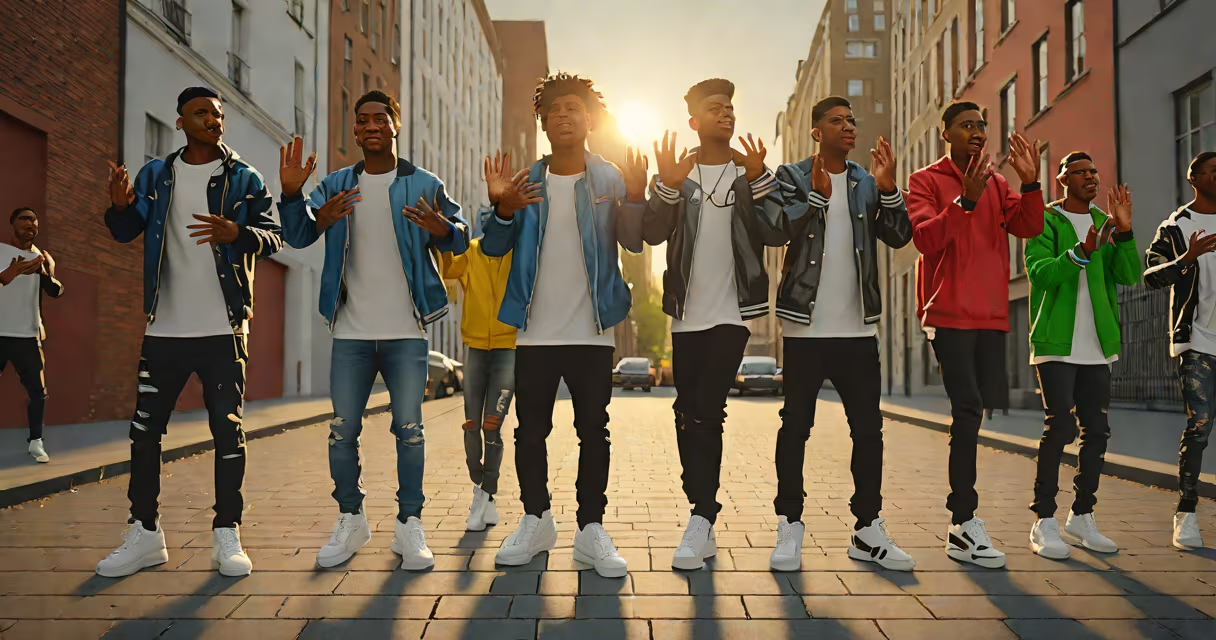
"Give me the beat boys" is a slang expression originating in 1980s and 1990s hip-hop culture, used to demand rhythmic intensity during live performances or music production. It signals a request for strong, clear percussion-often from a drummer or DJ-to drive the energy of a track or scene.
The phrase emerged from the early days of hip-hop, when DJs and MCs performed in city blocks, parks, and underground clubs. In those settings, the beat wasn't just background-it was the engine. A crowd would shout "Give me the beat boys!" to prompt the DJ or drummer to emphasize the kick drum and snare, creating a pulse that unified dancers and rappers alike.
It's not a musical term in formal theory, nor is it used in recording studios as a technical instruction. Instead, it's a cultural command rooted in performance energy. The phrase reflects how rhythm functions as both physical and emotional force in live hip-hop environments.
When someone shouts "Give me the beat boys," they're not asking for a metronome or a tempo map. They're demanding presence-the kind of rhythm that makes feet move and bodies sway. This happens most often in live settings: block parties, open mics, freestyle battles, or even during rehearsals.
For example, during a 1992 Bronx rap battle, an MC paused mid-verse and yelled, "Give me the beat boys!" The DJ responded by dropping a four-on-the-floor kick pattern and layering a snare on every downbeat. Within two seconds, the crowd erupted. The phrase didn't just ask for rhythm-it activated it.
It's also used in informal music sessions. A producer might say it while testing a new loop, prompting a collaborator to tighten the hi-hat pattern or emphasize the bass drum. In this way, it functions as a verbal cue for sonic focus.
The phrase relies on three core elements: the physicality of rhythm, the tradition of call-and-response, and shared cultural memory. The beat is not abstract-it's felt in the chest, heard in the floorboards. When a group shouts "Give me the beat boys," they're not asking for silence or stillness. They're calling for motion.
Call-and-response structures are central to African diasporic music traditions. In West African drumming, a lead drummer sets a phrase, and the ensemble echoes it. Hip-hop adapted this model: the MC speaks, the beat responds. "Give me the beat boys" is a modern version of that ancient structure-a demand for the collective to lock in.
It's also tied to generational identity. Older listeners recognize it as part of the golden era of hip-hop. Younger fans may hear it in films like *Boyz n the Hood* (1991) or *Menace II Society* (1993), where characters shout it during scenes of tension or celebration. These references reinforce its role as a marker of authenticity.
"Give me the beat boys" appears most frequently in live settings-concerts, open mics, dance circles, and rehearsal spaces. It's rare in studio recordings or official releases. You won't find it in liner notes or song credits. But in a basement jam session in Atlanta or a sidewalk performance in Brooklyn, it surfaces naturally.
It's used to reset energy. If a track feels flat, someone might shout it to recenter the rhythm. If a dancer loses sync, the cry brings attention back to the pulse. It's a social tool, not a technical one.
It's also used ironically or playfully. In a 2016 episode of *Atlanta*, the character Darius says "Give me the beat boys" while dancing in a grocery store. The line isn't literal-it's absurd, exaggerated. But the audience laughs because they recognize the phrase's cultural weight. It's a shared language.
People often mistake "give me the beat boys" for a generic request for music. That's incorrect. It's not "play something loud." It's specifically about rhythm-about the foundational groove. Saying "Give me the beat boys" is different from saying "Turn up the volume" or "Play the bassline."
Another common error is treating it as a command to a machine. Some assume it's a phrase used in digital audio workstations (DAWs). But it's not. It's human-centered. You don't say "Give me the beat boys" to a software plugin. You say it to a person-a drummer, a DJ, a performer.
A third misconception: that it's a gendered phrase. It's not. While often shouted by men in media, women and non-binary people have used it too. In 1995, rapper Queen Latifah used the phrase during a live show in New York City, directing it at her band. She said, "I'm not asking for a solo-I want the beat boys to come through."
The phrase exists in several forms, depending on region, generation, and intent. Below are common variants:
| Variation | Usage Context | Meaning |
|---|---|---|
| Give me the beat boys | Live performance, block party | Request for strong, clear rhythm to energize the crowd |
| Beat boys, give me the fire | Freestyle battle, spoken word | Demands high-energy rhythm to match intense delivery |
| Where's the beat boys? | Rehearsal, informal jam | Expresses frustration with weak or missing rhythm |
| Y'all better bring the beat boys | Urban youth culture, social media | Playful challenge to deliver strong rhythm |
These variations reflect regional dialects and evolving usage. In Chicago, "beat boys" sometimes refers to a specific crew of local drummers. In Los Angeles, it's used in graffiti-covered subway stations during late-night sessions.
"Give me the beat boys" is not a phrase that originated in the South Bronx. While it's strongly associated with 1980s hip-hop, its roots go deeper. In the 1960s, Jamaican sound system crews used similar calls-"Give me the rhythm!"-to control crowd energy during dancehall events. These phrases traveled through Caribbean migration and influenced early hip-hop culture in New York.
According to Dr. K. M. Brown, author of *Rhythm and Resistance: Music in the Black Diaspora* (2008), "The call-and-response format in 'Give me the beat boys' mirrors patterns found in Afro-Caribbean religious ceremonies, where the congregation responds to a leader's chant. This continuity shows how rhythm functions as a form of communal resistance and unity."
I once attended a poetry slam in Detroit where a spoken-word artist paused mid-verse and shouted, "Give me the beat boys!" The room fell silent for half a second-then the percussionist dropped a single kick drum hit. The entire audience leaned forward. It wasn't a performance trick. It was a moment of shared recognition. The phrase had done its job: it created urgency, focused attention, and brought everyone together.
"Give me the beat boys" is not a metaphor. It's not a poetic device. It's a direct, physical demand for rhythm. It's not about lyrics, not about melody. It's about the beat-the foundation. When someone says it, they're asking for the heartbeat of the music.
Understanding this phrase requires listening-not just hearing. It's not about decoding words. It's about feeling the space between beats, the pause before the kick hits. That's where the power lies.