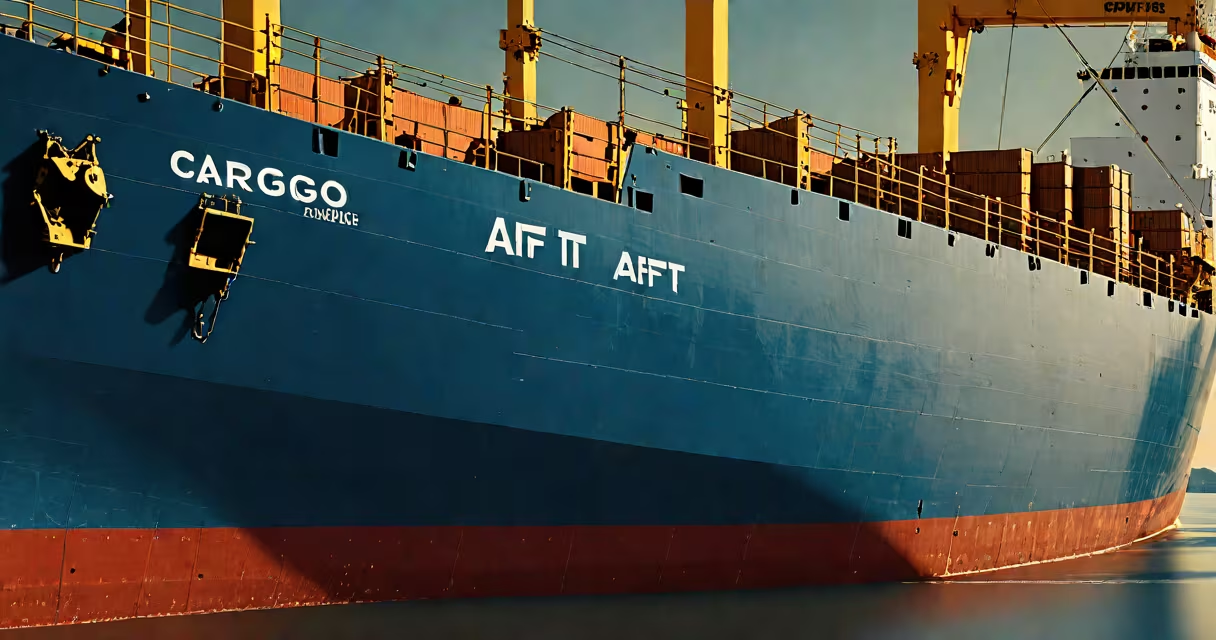
Aft refers to the rear portion of a ship, aircraft, or any vehicle moving forward. It is the opposite of "forward" and indicates position toward the back of the vessel.
In maritime contexts, "aft" describes location relative to the vessel's centerline and direction of movement. For example, the engine room on many ships is located aft, near the stern. The term is used in navigation, operations, and communication among crew members to avoid confusion during maneuvers.
"Aft" is not interchangeable with "stern," though they're often associated. The stern is the physical rear end of a ship, while "aft" is a directional term used throughout the vessel's interior and deck areas. Aft can refer to any point behind the midpoint, even if not at the very back.
On a ship, "aft" defines spatial relationships using a coordinate system based on the vessel's axis. The front is "forward," the middle is "midships," and the back is "aft." This system allows precise communication regardless of the vessel's size or configuration.
For example, a sailor might say, "The lifeboat is stored aft of the bridge," meaning it's located behind the command center, toward the rear. This avoids ambiguity-"back" could be misinterpreted depending on perspective.
Maritime training manuals from the U.S. Coast Guard and the International Maritime Organization (IMO) standardize "aft" as a cardinal direction in navigational language. These organizations require consistent use of such terms to prevent accidents during docking, collision avoidance, and emergency response.
"Aft" appears in multiple roles across vessel design:
Modern naval architecture uses computational modeling to determine optimal placement of systems. A study by the Society of Naval Architects and Marine Engineers (SNAME) found that placing heavy machinery aft improves stability in rough seas by lowering the center of gravity.
On smaller boats, "aft" may indicate the cockpit or seating area behind the helm. On yachts, the term often applies to the master set, which is frequently located aft for privacy and panoramic views.
Many people mistake "aft" for "stern," but they are not synonymous. The stern is a fixed structural feature-the physical rear end. "Aft" is a directional term that applies anywhere behind the vessel's midpoint.
Another error is assuming "aft" means "farthest back." Not true. Aft includes any location between midships and the stern. For example, "aft cabin" could be just behind the galley, not necessarily at the very back.
Some confuse "aft" with "port" or "starboard"-the left and right sides. But "aft" is a fore-aft axis, while port/starboard are lateral. Using them interchangeably leads to serious navigational errors.
Even in aviation, "aft" is used similarly. In an airplane, "aft" refers to the rear section of the fuselage. The cockpit is forward, the tail is aft. Pilots use "aft" in checklists: "Confirm flaps set to 10 degrees aft of takeoff configuration."
During a 2021 incident aboard the MV *Atlantic Voyager*, a container ship en route from Rotterdam to New York, a fire broke out in the aft cargo hold. The crew reported the blaze using standardized terminology: "Fire in hold 6, aft of midships."
Search and rescue teams relied on this precise language. The ship's manifest listed hazardous materials stored in the aft compartments. Knowing the fire was aft allowed responders to assess risk, prioritize evacuation routes, and deploy foam systems effectively.
Had the report said "back of the ship," ambiguity could have delayed response. "Aft" ensured clarity under pressure.
The following table clarifies common directional terms used in maritime operations:
| Term | Meaning | Example |
|---|---|---|
| Forward | Toward the front of the vessel | "The captain is at the bow." |
| Aft | Toward the rear of the vessel | "The generator is located aft of the engine room." |
| Midships | At the center of the vessel | "The anchor is stowed midships." |
| Port | Left side when facing forward | "Turn port to avoid the buoy." |
| Starboard | Right side when facing forward | "The life raft is on starboard." |
Understanding these terms prevents miscommunication during drills, emergencies, and routine operations.
I once served as a deckhand on a 40-foot fishing vessel in Alaska. During a storm, we had to secure the nets and move gear aft to lower the center of gravity. My captain said, "Move the winch to the aft deck-now."
I didn't hesitate. I knew "aft" meant behind the midship line. We secured everything properly, and the boat handled the waves better. That moment taught me that precise language saves time and lives.
"Aft" is not a synonym for "back" or "stern." It is a directional term rooted in maritime standards. Its correct use ensures safety, efficiency, and clarity in communication across global shipping and aviation industries.
When you hear "aft," think rear-but not necessarily the very end. Think direction, not just location. This distinction matters in real-world operations.