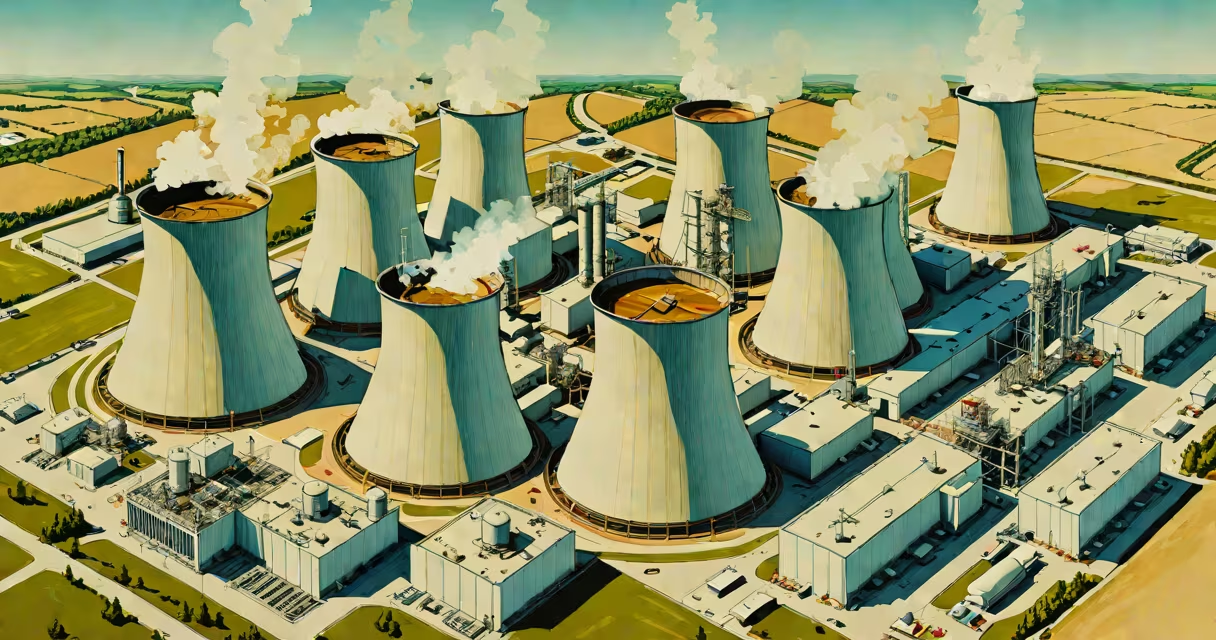
Nuclear power generates electricity through controlled fission of uranium or plutonium atoms, producing large amounts of energy with near-zero carbon emissions during operation. It offers consistent baseload power but faces challenges in waste disposal, accident risk, and high construction costs.
At its core, nuclear power relies on splitting heavy atomic nuclei-typically uranium-235-to release heat. That heat boils water, creating steam that spins turbines connected to generators. The process occurs inside a reactor vessel shielded by thick concrete and steel. A single fuel rod contains enough fissile material to power a typical home for over a year.
Unlike solar or wind, nuclear plants operate continuously, delivering stable output regardless of weather or time of day. They run at capacity factors above 90%, meaning they produce close to their maximum rated output nearly all the time. This reliability makes them ideal for meeting base demand in electricity grids.
Inside a nuclear reactor, neutrons strike uranium-235 atoms, causing them to split into smaller atoms and release additional neutrons. These new neutrons trigger further fissions, creating a chain reaction. Control rods made of boron or cadmium absorb excess neutrons to regulate the rate of fission.
The heat generated by fission is transferred via a coolant-usually water or liquid sodium-to a secondary loop where steam is produced. The steam drives a turbine connected to a generator, converting mechanical energy into electrical energy. After passing through the turbine, steam is cooled and condensed back into water, completing the cycle.
Modern reactors like the Westinghouse AP1000 and Areva EPR use passive safety systems. In case of overheating, gravity and natural convection automatically shut down the reactor and cool the core without needing pumps or external power. These designs reduce reliance on human intervention during emergencies.
Reactor types differ primarily in fuel, coolant, and neutron spectrum. Light-water reactors (LWRs), which use ordinary water as both coolant and moderator, dominate global installations. They include pressurized water reactors (PWRs) and boiling water reactors (BWRs).
| Type | Fuel | Coolant/Moderator | Common Use |
|---|---|---|---|
| PWR | Uranium-235 enriched to ~3-5% | Water (pressurized) | Most U.S. and European plants |
| BWR | Same as PWR | Water (boils directly) | Used in Japan and some U.S. sites |
| Fast Breeder Reactor (FBR) | Plutonium-239 or uranium-238 | Sodium (no moderator) | Experimental; produces more fuel than consumed |
| High-Temperature Gas-Cooled Reactor (HTGR) | Uranium dioxide in graphite matrix | Helium gas | Research and small modular applications |
Generation IV reactors aim to improve efficiency and safety. The molten salt reactor (MSR), for example, uses fluoride salts as both coolant and fuel carrier. It operates at atmospheric pressure, reducing explosion risk. France's CEA and the U.S. Department of Energy have tested prototype MSR designs since 2015.
Nuclear power emits virtually no greenhouse gases during operation. According to the International Atomic Energy Agency (IAEA), lifecycle emissions average 12 grams of CO₂ equivalent per kilowatt-hour-comparable to wind and lower than solar photovoltaic systems. This makes it a key tool in decarbonizing electricity grids.
A single nuclear power plant can generate over 1 gigawatt of continuous power. The Palo Verde Nuclear Generating Station in Arizona supplies electricity to more than 1.3 million homes and accounts for roughly 20% of the state's total generation. Its 3 reactors operate at 93% capacity factor annually, far exceeding most renewable sources.
Nuclear fuel is highly energy-dense. One uranium pellet-about the size of a fingertip-contains as much energy as 17,000 cubic feet of natural gas or 1 ton of coal. This density reduces transportation and storage needs compared to fossil fuels. The U.S. Department of Energy reports that a single nuclear power plant requires less than 1 acre of land per gigawatt of capacity, less than solar farms.
Spent nuclear fuel remains radioactive for hundreds of thousands of years. The U.S. currently stores used fuel at reactor sites due to delays in establishing a permanent repository. The proposed Yucca Mountain facility in Nevada was abandoned in 2010 after political opposition and technical concerns about groundwater contamination.
Construction timelines for new nuclear plants often exceed 10 years. The Vogtle Units 3 and 4 in Georgia, expected to begin operations in 2023, faced cost overruns of $1.6 billion and delays of over five years. The project's final cost reached $30 billion-more than double the original estimate-due to regulatory changes and labor shortages.
Accidents, though rare, carry severe consequences. The 1986 Chernobyl disaster released radiation equivalent to 400 Hiroshima bombs. The 2011 Fukushima Daiichi incident resulted in the evacuation of 150,000 people and long-term contamination of agricultural land. Both events led to widespread public distrust and policy shifts in Germany, Japan, and Belgium.
Nuclear power is not inherently unsafe. The World Health Organization (WHO) states that the number of deaths per terawatt-hour from nuclear energy is lower than those from coal, oil, or even solar photovoltaics when accounting for air pollution and manufacturing impacts. Over 60 years, nuclear power has caused fewer fatalities per unit of energy than any major energy source.
Another myth is that nuclear waste is unmanageable. Finland's Onkalo deep geological repository, operational since 2023, stores spent fuel in granite bedrock 400 meters underground. The facility aims to isolate waste for 100,000 years using multiple engineered and natural barriers. It is the first operational permanent disposal site globally.
During a 2019 field visit to a French nuclear facility, I observed automated robotic systems handling spent fuel rods in shielded casks. The process involved remote-controlled cranes and sealed transfer tunnels. Radiation levels outside the containment zone were indistinguishable from background-proof that rigorous engineering controls minimize exposure risks.
Nuclear power outperforms fossil fuels in carbon intensity and air quality impact. However, it lags behind solar and wind in deployment speed and scalability. Solar PV installations grew by 22% annually between 2015 and 2022, while nuclear additions averaged just 1.5% per year worldwide.
Hydroelectric power provides similar baseload capabilities but depends on geography and seasonal rainfall. The Hoover Dam generates 4.2 gigawatts, but droughts reduced output by 30% in 2021. In contrast, nuclear plants maintain output regardless of climate fluctuations.
Small modular reactors (SMRs) represent a potential middle ground. Designs like NuScale's 60-megawatt module can be factory-built and shipped to sites. They offer lower capital costs and enhanced safety features. The U.S. Nuclear Regulatory Commission approved the first SMR design in 2023, paving the way for pilot projects in Idaho and Wyoming.
nuclear power pros and cons reveal a complex trade-off between energy security, environmental protection, and long-term risk. While it delivers high-output, low-carbon electricity, it demands significant investment, strict regulation, and public acceptance. Countries like France and Sweden derive over 70% of their electricity from nuclear sources, demonstrating viability at scale. Yet, others like Germany have phased out reactors entirely, prioritizing renewables despite higher intermittency.
For policymakers, the decision hinges on balancing immediate energy needs with long-term sustainability. Nuclear power is not a universal solution-but in regions with limited renewable resources or high grid demand, it remains a critical component of a diversified energy mix. The future may lie not in choosing between options, but in integrating them strategically.