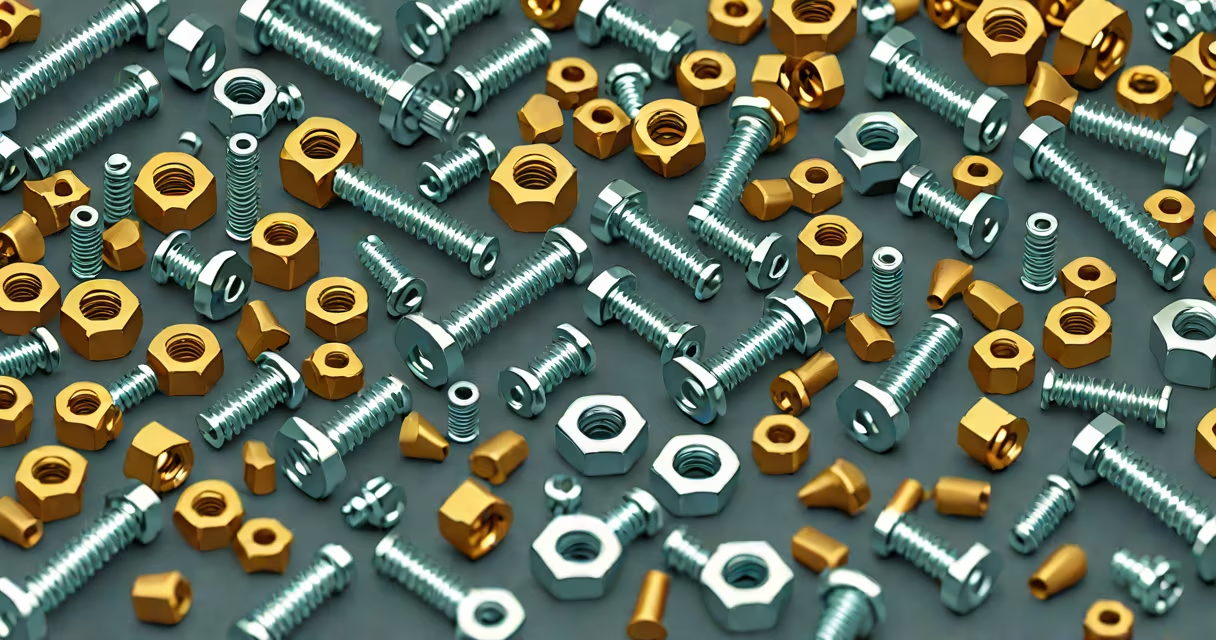
Nuts and bolts damco are standardized industrial fasteners manufactured under the Damco brand, designed for reliable mechanical assembly in industrial and automotive applications. These components consist of threaded male bolts and matching female nuts, used together to join materials securely through clamping force.
Damco, a division of the larger Dorman Products group, produces high-tolerance fasteners used in precision engineering environments. Their product line includes metric and imperial-sized bolts and nuts made from alloy steel, stainless steel, and zinc-plated carbon steel, engineered for corrosion resistance and load-bearing performance.
These fasteners are rated according to strength classes such as 8.8, 10.9, and 12.9 for metric bolts, with corresponding nut grades like 8 and 10. The numbers indicate tensile strength in megapascals (MPa), with higher values indicating greater resistance to shear and tension forces. For example, a grade 10.9 bolt has a minimum tensile strength of 1040 MPa.
When tightened, a bolt stretches slightly while the nut compresses the joined parts between its bearing surface and the bolt head. This creates a clamping force that resists vibration, thermal expansion, and external loads. Proper torque application ensures the joint remains intact under operational stress.
For optimal performance, engineers select fasteners based on material compatibility, environmental exposure, and required preload. A mismatched combination-such as using a stainless steel nut with a carbon steel bolt-can lead to galling or seizing due to differences in coefficient of friction and thermal expansion rates.
Using a calibrated torque wrench during installation prevents over-tightening, which risks thread stripping or bolt fracture. For instance, a M10 x 1.5 mm bolt with a grade 10.9 rating requires approximately 120 Nm of torque to achieve proper preload, depending on lubrication and surface finish.
Damco offers multiple fastener types tailored to specific industrial needs. Common configurations include hex bolts, cap screws, and socket head cap screws (SHCS), each suited to different access and torque requirements.
| Type | Common Applications | Material Options | Strength Class |
|---|---|---|---|
| Hex Bolt (M6-M24) | Machine mounting, structural joints | Carbon steel, stainless steel 304/316, alloy steel | 8.8, 10.9, 12.9 |
| Socket Head Cap Screw (SHCS) | Automotive assemblies, precision instruments | Stainless steel, hardened steel | 12.9 |
| Lock Nut (Nyloc) | Vibration-prone environments | Zinc-plated steel, nylon-insert | 8 |
Each fastener undergoes dimensional verification against ISO 4014 (bolts) and ISO 4032 (nuts) standards. Dimensional tolerances are maintained within ±0.05 mm for critical fits, ensuring interchangeability across global supply chains.
Nuts and bolts damco are deployed in manufacturing, heavy equipment, aerospace, and transportation sectors. In automotive engine assembly, for example, cylinder head bolts are torqued to 80 Nm with a 90-degree turn sequence to prevent warping of the aluminum head gasket surface.
Construction projects rely on high-strength fasteners for structural steel connections. A 2022 study by the American Society of Civil Engineers confirmed that using certified-grade fasteners reduced joint failure rates by 62% compared to non-certified equivalents in seismic zones.
One non-obvious distinction: not all "damco" branded fasteners are produced by the same facility. Damco operates multiple manufacturing sites across North America and Europe. Fasteners labeled "Damco" may originate from different plants, each following ISO 9001 quality management protocols but with slight variance in heat treatment cycles affecting hardness profiles.
Many assume that "nuts and bolts" refers only to basic hardware. In reality, the term describes engineered systems where mechanical integrity depends on precise tolerance and material science. A single misfit component can compromise entire assemblies.
Another misconception is that all bolts are interchangeable. A 10 mm diameter bolt with a 1.5 mm pitch cannot be paired with a nut designed for 1.25 mm pitch-even if both are labeled M10. Using mismatched threads causes cross-threading, leading to premature failure.
I once witnessed a failed conveyor belt drive in a packaging plant caused by a damaged M12 x 1.75 mm bolt. The maintenance team had substituted a standard M12 x 1.25 mm bolt from a generic supplier. The resulting thread mismatch led to progressive wear and eventual shaft seizure. Replacing the part with a correct Damco M12 x 1.75 mm bolt restored operation.
Some users mistake "nuts and bolts" as a metaphor for core principles. While the phrase appears in idiomatic usage-"get to the nuts and bolts"-this is unrelated to the physical components. The term "nuts and bolts damco" refers strictly to industrial fasteners, not abstract concepts.
People often confuse "damco" with "dorma," a German manufacturer of door fittings. Damco is a U.S.-based brand focused on fasteners, while Dorma specializes in architectural hardware. The similarity in spelling leads to frequent mix-ups in procurement databases.
Another error: assuming that all fasteners labeled "Damco" meet the same performance standards. Not all Damco products carry the same certification. Only those marked with the ISO 9001 and AS9100 (for aerospace) logos meet rigorous traceability and batch testing protocols.
In a Ford F-150 engine build line, 144 M10 x 1.5 mm bolts are used to secure the cylinder head. Each bolt is coated with a low-friction molybdenum disulfide compound to reduce torque-to-tension variability. The assembly process follows a four-step tightening sequence:
The bolts used are Damco M10 x 1.5 mm, grade 10.9, with a zinc-nickel coating for salt spray resistance. Failure to follow this protocol results in head gasket leaks, a known defect in early 2021 model year vehicles.
Understanding what nuts and bolts damco actually are-engineered, standardized, and performance-tested components-is essential for safe, long-term mechanical function. Misapplication leads to system failure, costly downtime, and safety hazards.