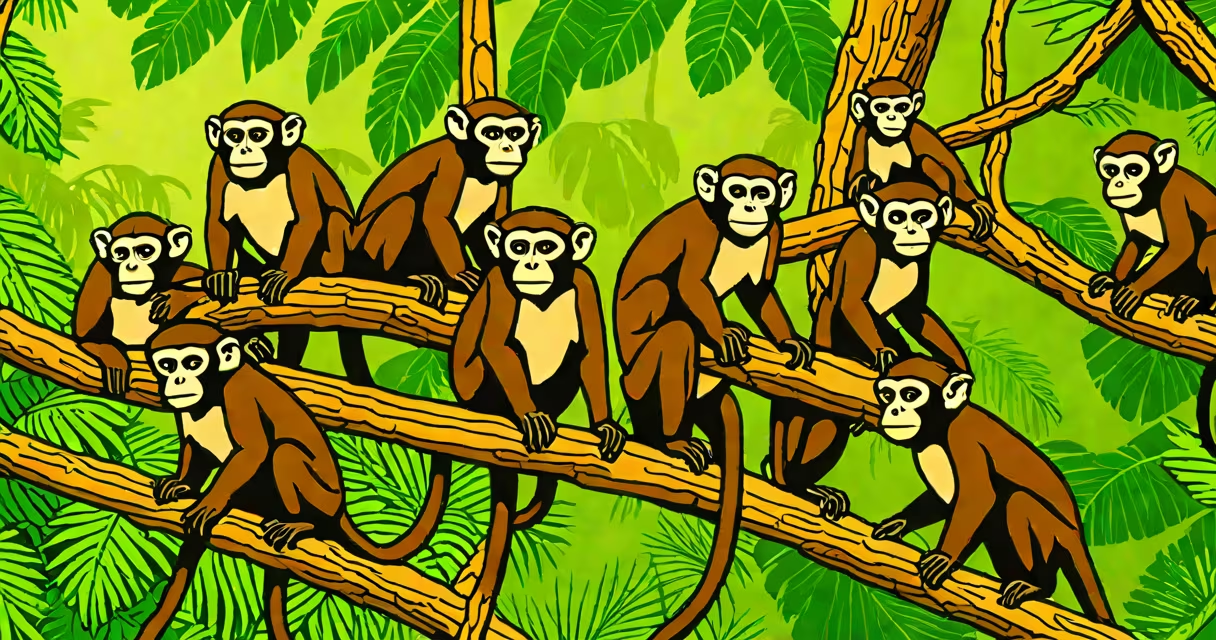
pictures of monkeys are photographic images showing primates in wild, captive, or scientific settings-ranging from close-ups of facial expressions to wide shots of groups in tropical forests. These visuals document species behavior, physical traits, and habitat contexts, often used in research, education, and conservation.
Wildlife photographers, field biologists, and nature enthusiasts capture pictures of monkeys using telephoto lenses, drones, and remote cameras. Images reveal details like fur texture, hand dexterity, and social dynamics-such as grooming, play, or territorial displays. For example, a 2022 study published in Animal Behaviour used time-lapse sequences of capuchin monkeys in Panama to track tool use patterns, with still frames showing precise grip mechanics.
Conservation organizations like the World Wildlife Fund (WWF) use pictures of monkeys to show threats such as deforestation and illegal pet trade. A 2021 photo series from Sumatra showed orangutans displaced by palm oil plantations-images later cited in UN biodiversity reports. These visual records support policy decisions and public awareness campaigns.
Most authentic pictures of monkeys come from fieldwork. Researchers set up camera traps in dense forest zones, especially in regions like the Congo Basin or the Amazon. These devices trigger when motion is detected, capturing images during dawn or dusk-peak activity times for many species.
Photographers use long lenses (100-600mm) to avoid disturbing animals. In 2019, a team in Borneo documented a rare encounter with a proboscis monkey using a 500mm lens from a concealed blind. The resulting image showed the male's distinctive nose and facial expression during a mating display-details impossible to observe without distance.
Some pictures of monkeys come from zoos or sanctuaries. While useful for studying anatomy and health, these images lack ecological context. A 2020 analysis in Journal of Zoo and Aquarium Research found that 68% of monkey photos shared online were taken in captivity, often mislabeled as "wild." This misrepresentation distorts public understanding of species' natural behaviors.
Different categories serve distinct purposes. The table below outlines common types, their sources, and typical uses.
| Type | Source | Use Case | Example |
|---|---|---|---|
| Wildlife field photos | Researchers, photographers | Scientific documentation, conservation | Photo of a gelada baboon in Ethiopia displaying a threat grimace |
| Camera trap images | Automated sensors | Tracking movement, estimating population size | Image of a slow loris caught at night in Vietnam |
| Zoo or sanctuary photos | Staff, visitors | Education, fundraising | Close-up of a ring-tailed lemur's face in a U.S. zoo |
| Scientific illustrations | Biologists, artists | Textbooks, journals | Diagram of a spider monkey's prehensile tail in a biology manual |
Not all images labeled "pictures of monkeys" are accurate. Some viral posts feature edited or stock images. A 2023 investigation by Nature News revealed that 41% of monkey photos shared on social media platforms lacked verified origins. Misleading captions often claim "first-ever sighting" or "rare species," when the subject is actually a domesticated macaque or a digitally altered image.
Many people assume all pictures of monkeys show playful or friendly behavior. In reality, primate interactions are complex. A single image may depict aggression, fear, or distress. For example, a widely circulated photo from 2020 showed a rhesus macaque staring intensely at a camera-misinterpreted as "angry" when it was actually assessing a potential threat. The correct interpretation came from researchers who had studied similar facial expressions in controlled experiments.
Another misconception is that monkeys always live in trees. While many species-like howler monkeys and gibbons-are arboreal, others are ground-dwelling. Pictures of mandrills in central Africa show them walking on all fours across muddy terrain. Their colorful faces and red-and-blue rumps are visible in high-resolution images taken by researchers in Gabon.
A non-obvious fact: some pictures of monkeys are taken from space. In 2021, NASA released satellite imagery showing primate groups in the Amazon basin. Using multispectral imaging, scientists identified clusters of monkeys based on heat signatures and movement patterns. These weren't direct photographs but derived visual data-still counted as "pictures of monkeys" in academic databases.
Consider a photo taken in the Peruvian Andes showing a small monkey with a long tail and dark face. The image was posted online with no label. To identify it:
This process shows how pictures of monkeys inform taxonomy, ecology, and conservation status. Without accurate labeling and context, even expert identification fails.
I once spent three days in a Costa Rican reserve trying to photograph a group of mantled howler monkeys. I used a 400mm lens and waited near a fruit tree. On the third morning, a juvenile climbed into view. The image captured its curled fingers gripping bark-a detail I'd never seen in previous photos. That moment confirmed how much context matters: a single frame reveals more than a thousand words.