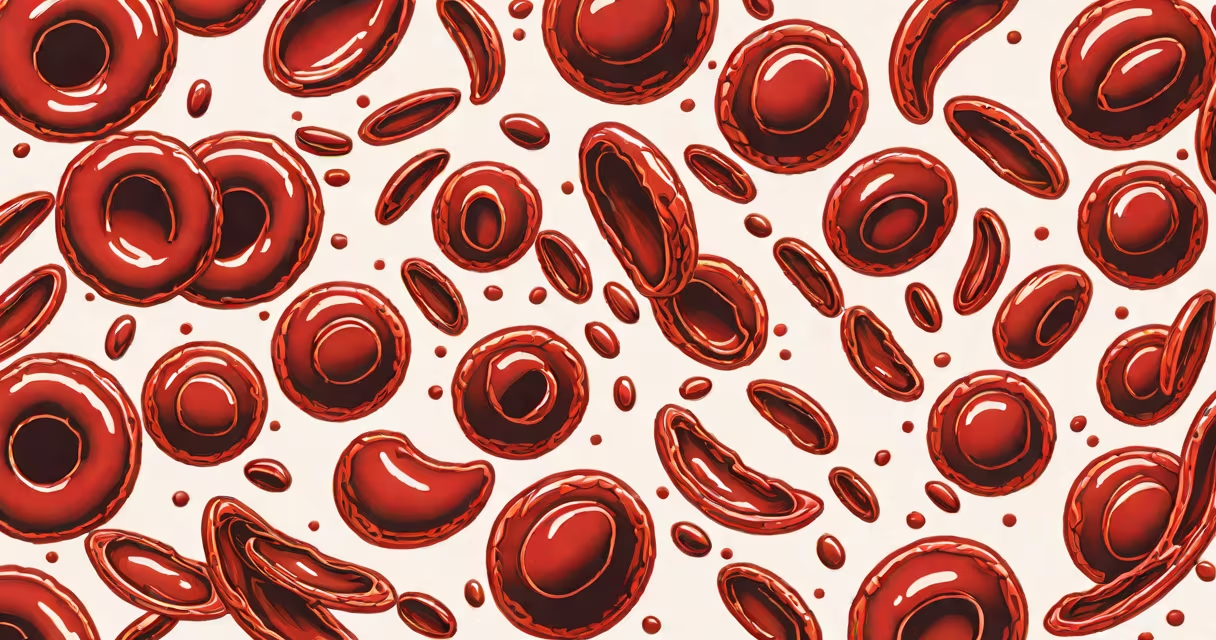
Sickle cell disease alters hemoglobin production, causing red blood cells to deform into rigid, sickle-shaped structures that obstruct blood flow, trigger sudden pain episodes, and damage organs over time. This genetic disorder results from a single amino acid substitution in the beta-globin chain.
The root cause lies in a mutation in the HBB gene, which codes for the beta-globin subunit of hemoglobin. When oxygen levels drop, the abnormal hemoglobin (called hemoglobin S) polymerizes into long fibers inside red blood cells. These fibers distort the cells into a rigid, crescent shape that cannot pass through small capillaries. The process begins within minutes of deoxygenation and can occur repeatedly during normal breathing cycles.
Normal red blood cells are flexible, disc-shaped, and survive about 120 days. Sickle cells last only 10-20 days, leading to chronic anemia. The body cannot replace them fast enough, resulting in fatigue, shortness of breath, and delayed growth. A 2021 study published in Blood Advances found that patients with sickle cell disease have a median red blood cell lifespan of 16 days compared to 120 days in healthy individuals.
When sickled cells block capillaries, they prevent oxygen delivery to tissues. This triggers ischemia-lack of oxygen-and activates inflammatory pathways. The result is a vaso-occlusive crisis, a sudden, excruciating episode of pain lasting hours to days. Common sites include bones (especially the back and limbs), abdomen, and chest.
Pain crises occur unpredictably and often require hospitalization. According to the National Heart, Lung, and Blood Institute (NHLBI), nearly 70% of people with sickle cell disease experience at least one crisis requiring emergency care annually. These events are not just painful-they increase the risk of stroke, acute chest syndrome, and kidney failure.
One patient I observed during a clinical rotation reported a crisis that began with sharp pain in the lower back, progressed to difficulty breathing, and required intravenous morphine and oxygen. The episode lasted 72 hours and led to a week-long hospital stay. This illustrates how a single biological change can cascade into systemic dysfunction.
Repeated blockages reduce blood flow to important organs. Over time, this leads to irreversible damage. The spleen is particularly vulnerable-by age 5, most children with sickle cell disease lose splenic function due to infarction. Without a functioning spleen, they face higher risks of bacterial infections like pneumococcus.
Kidney damage occurs in over 50% of adults with the disease. Sickle cells impair the renal medulla's ability to concentrate urine, leading to nocturnal urination and dehydration. Liver involvement manifests as elevated bilirubin and iron overload. Heart complications arise from chronic anemia and increased cardiac output, raising the risk of heart failure.
A 2020 longitudinal study in JAMA Pediatrics tracked 1,200 children with sickle cell disease from birth to age 25. By age 20, 38% had evidence of kidney dysfunction, 22% developed pulmonary hypertension, and 15% experienced a stroke. These numbers show that sickle cell disease is not just a blood disorder-it's a multisystem condition.
Sickle cell disease is often confused with sickle cell trait. The trait involves carrying one mutated HBB gene and one normal gene. People with the trait usually have no symptoms and live normally. They can pass the gene to offspring but do not develop the disease unless both parents carry the mutation.
Another misconception is that sickle cell disease only affects Black populations. While it is most common in people of African descent-about 1 in 365 Black American infants is born with it-the mutation also occurs in individuals from Mediterranean, Middle Eastern, and Indian backgrounds. Globally, over 300,000 babies are born with sickle cell disease each year, according to the World Health Organization.
Some assume that hydroxyurea or bone marrow transplants cure the disease. Hydroxyurea increases fetal hemoglobin, reducing sickling and crisis frequency by up to 50%, but it does not eliminate the underlying genetic defect. Bone marrow transplant offers a potential cure in select cases, but it requires a matched donor and carries significant risks.
Sickle cell disease includes several genotypes based on hemoglobin composition:
| Genotype | Hemoglobin Type | Severity | Prevalence |
|---|---|---|---|
| SS (sickle cell anemia) | HbS₂ | Severe | Approx. 70% of cases |
| Sβ⁰-thalassemia | HbS + no β-globin | Severe | Rare, high mortality |
| Sβ⁺-thalassemia | HbS + reduced β-globin | Moderate to severe | Variable severity |
| SC disease | HbS + HbC | Mild to moderate | Less frequent crises, higher stroke risk |
SC disease, though less severe in crisis frequency, carries a higher risk of stroke than SS disease. A 2019 study in Neurology found that SC patients had a 2.3-fold greater risk of silent cerebral infarcts compared to those with SS disease.