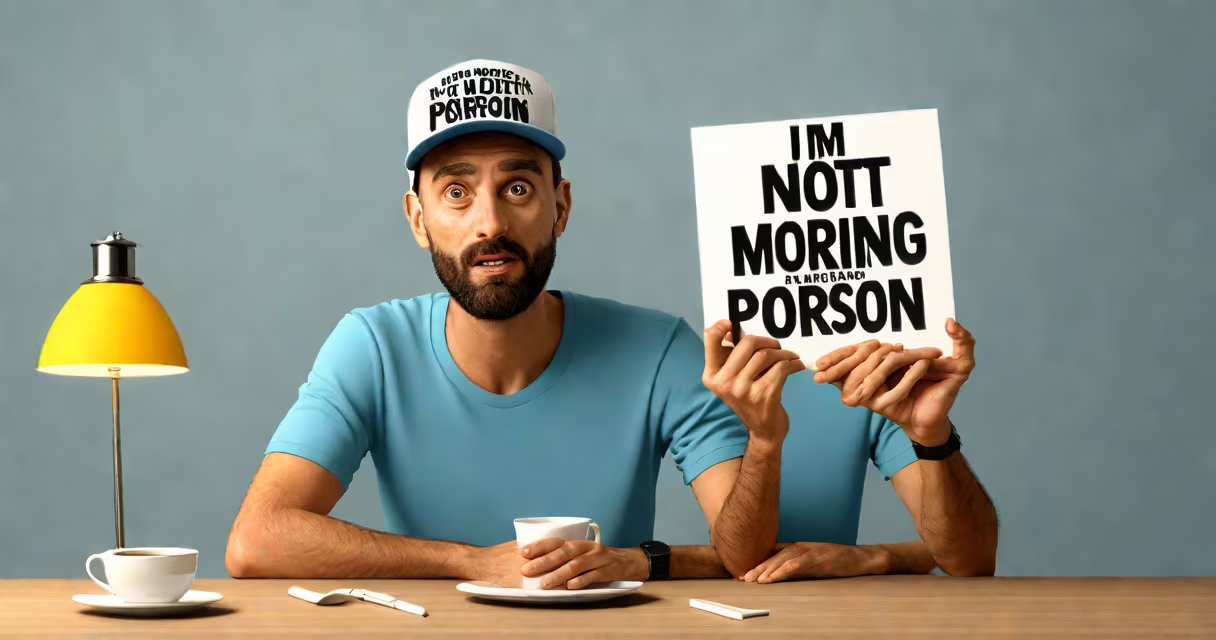
A very bad dad joke is a predictable, pun-based joke that relies on forced wordplay, often involving homophones, double meanings, or absurd logic. These jokes are intentionally awkward, designed to elicit groans rather than laughter. They're typically delivered with a flat tone and a knowing smile.
They work because they subvert expectations. The listener anticipates a punchline that makes sense logically. Instead, the joke twists language in a way that's illogical but phonetically plausible. This mismatch creates the cringe effect that defines the genre.
For example: "I'm reading a book about anti-gravity. It's impossible to put down." The humor lies in the double meaning of "put down"-literally placing a book on a surface, or being unable to stop reading it. The joke fails on logic but succeeds on sound.
These jokes follow a basic structure: setup, misdirection, and payoff through wordplay. The setup introduces a scenario or concept. The misdirection builds tension by suggesting a logical resolution. The payoff arrives via a pun that breaks the expected pattern.
The effectiveness of a very bad dad joke doesn't come from cleverness. It comes from predictability. Listeners know the format. They anticipate the punchline. The humor arises from the gap between expectation and delivery-the moment the brain realizes the joke is terrible.
Psychologists have studied this phenomenon. According to research published in *Cognition and Emotion*, people find humor in violations of expectation-especially when the violation is mild and harmless. A very bad dad joke fits this model perfectly: it breaks linguistic rules in a way that's safe and repetitive.
While variations exist, most very bad dad jokes fall into recurring categories:
| Type | Example | Why It Works (or Fails) |
|---|---|---|
| Homophones | "I told my wife she was drawing her eyebrows too high. She looked surprised." | Relies on the double meaning of "surprised" as both emotional state and physical position. |
| Double Entendre | "I'm friends with 25 letters of the alphabet. I don't know Y." | Uses "Y" as both a letter and the pronoun "why," creating a false connection. |
| Literal Interpretation | "I used to be a baker, but I couldn't make enough dough." | "Dough" means money and bread. The joke fails because it's too obvious. |
These tropes repeat across generations. The same joke appears in schoolyard lore, family gatherings, and online meme formats. Their endurance proves their function: social bonding through shared embarrassment.
Very bad dad jokes appear in homes, classrooms, and workplaces. Parents tell them to children during car rides. Teachers deploy them to break tension after exams. Colleagues use them to ease awkward silences in meetings.
They serve a purpose beyond amusement. Research from the University of Oxford shows that self-deprecating humor-like telling a terrible joke-can reduce social anxiety and build rapport. When someone tells a very bad dad joke, they're signaling: "I'm not trying to impress you. I'm just here to connect."
I once watched a father tell his daughter a joke about a fish who couldn't swim. He paused, looked at her blankly, then said, "He was a little out of his depth." The girl groaned, rolled her eyes, and laughed. That moment wasn't about the joke-it was about the shared ritual. The dad didn't care if it was funny. He cared that she was listening.
People often mistake very bad dad jokes for low-quality humor. But they aren't meant to be good. Their value lies in their failure. A successful very bad dad joke is one that makes you groan loudly and say, "Oh god, why?"
Another myth: these jokes are only for kids. Not true. Adults use them to disarm tension. A coworker once opened a team meeting with, "I'm not sure if I'm ready for this. I've got a lot on my plate." The room went quiet. Then someone groaned. Then everyone laughed. The joke wasn't clever. It was effective.
There's also confusion between very bad dad jokes and other forms of humor. They differ from sarcasm, irony, or absurdist comedy. Dad jokes rely on familiarity and repetition. They're not surprising-they're predictable. That predictability is the point.
To recognize a very bad dad joke, look for these signs:
When you hear one, don't try to fix it. Don't explain why it's bad. Just say, "That was awful," and move on. The joke isn't about the quality-it's about the moment.
Understanding the very bad dad joke reveals something deeper: humans seek connection through shared failure. The worst joke isn't the enemy of fun-it's its ally.