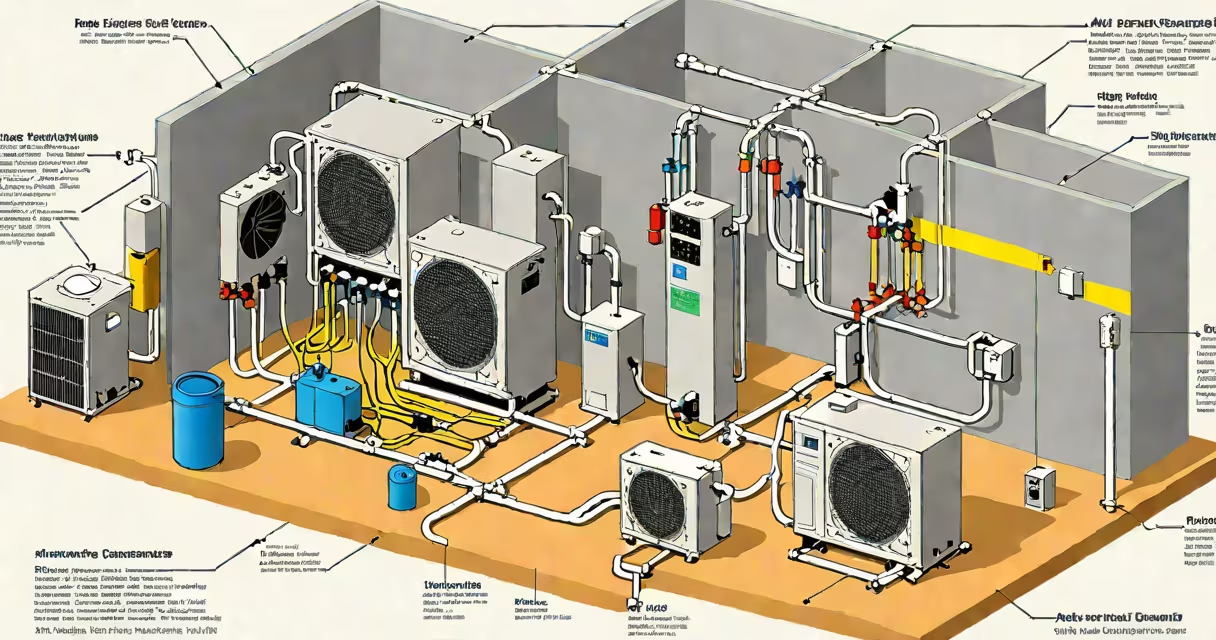
An air conditioner consists of four core components: the compressor, condenser coil, evaporator coil, and expansion valve, working together with refrigerant to transfer heat from indoors to outdoors. This process cools indoor air and reduces humidity.
The system operates on a closed-loop refrigeration cycle. Refrigerant absorbs heat inside the home through the evaporator coil, then travels to the outdoor unit where the compressor pressurizes it. High-pressure refrigerant releases heat through the condenser coil, and after passing through the expansion valve, it returns to the indoor unit to repeat the cycle.
Modern air conditioners often include additional elements such as a blower fan, thermostat, drain pan, and electrical controls. These ensure consistent temperature regulation, proper airflow, and safe operation. The entire system relies on precise pressure and temperature differentials maintained by the components.
The compressor, located in the outdoor unit, acts as the heart of the system. It raises the pressure and temperature of the refrigerant gas, enabling it to release heat when it reaches the condenser coil. Without the compressor, the refrigerant cannot move through the cycle effectively.
The condenser coil, also in the outdoor unit, dissipates heat from the compressed refrigerant into the outside air. A fan blows ambient air across the coil, cooling the refrigerant so it can transition from gas to liquid. This phase change allows efficient heat rejection.
Inside the home, the evaporator coil absorbs heat from indoor air. As warm air passes over the cold coil, moisture condenses and drains away. The refrigerant absorbs heat while changing from liquid to gas, which then flows back to the compressor to restart the cycle.
The expansion valve regulates the flow of refrigerant into the evaporator coil. It reduces pressure, allowing the refrigerant to cool rapidly. A malfunctioning expansion valve can cause poor cooling, ice buildup, or inefficient operation.
Split systems are the most common residential setup. They separate the indoor and outdoor components. The indoor unit houses the evaporator coil and blower fan, while the outdoor unit contains the compressor, condenser coil, and fan. This design improves efficiency and reduces indoor noise.
Window units integrate all components into a single box installed in a window or wall. They are less efficient than split systems due to limited space and exposure to outdoor temperatures. However, they are cost-effective for small rooms and temporary cooling needs.
Central air conditioning uses a furnace or air handler with a large evaporator coil. The system cools air distributed through ductwork. It requires a dedicated outdoor condensing unit and is ideal for whole-home cooling in larger homes.
| System Type | Indoor Unit | Outdoor Unit | Best For |
|---|---|---|---|
| Split System | Evaporator coil, blower fan | Compressor, condenser coil, fan | Most homes, balanced efficiency and noise control |
| Window Unit | All components in one box | Same box, external exhaust | Small rooms, rentals, budget installations |
| Central AC | Large air handler with coil | Separate condenser unit | Whole-house cooling, larger homes |
Many people assume that air conditioners "create cold." They do not. Instead, they move heat from inside a building to the outside. The indoor unit removes thermal energy from the air, lowering the temperature. The outdoor unit expels that heat into the environment.
Another misconception is that refrigerant is consumed during operation. Refrigerant circulates continuously in a sealed loop. It does not burn or deplete. Leaks require repair because refrigerants like R-410A are regulated under the U.S. Environmental Protection Agency's (EPA) Clean Air Act.
A critical distinction: the evaporator coil is not the same as the air filter. The filter traps dust and debris to protect the blower and coil. The coil handles heat exchange. A clogged filter restricts airflow, causing the coil to freeze and reducing cooling capacity.
A 13,500 BTU split system air conditioner typically serves a room between 500 and 700 square feet. It uses a 1.5-ton compressor, a 16-SEER-rated condenser coil, and a variable-speed blower. The refrigerant line connects the indoor and outdoor units.
During operation, the indoor blower pulls warm air across the cold evaporator coil. The refrigerant absorbs heat and turns into low-pressure vapor. The vapor travels through the copper line to the outdoor unit, where the compressor increases pressure and temperature. The hot gas enters the condenser coil, releasing heat to the outside air. The cooled refrigerant then passes through the expansion valve, drops in pressure, and returns to the indoor unit.
This cycle runs continuously until the thermostat signals that the desired temperature is reached. A typical 13,500 BTU unit consumes about 1,200 watts per hour under peak load. Over 8 hours of daily use, it uses roughly 9.6 kWh per day.
I once replaced the expansion valve on a 10-year-old split system that had stopped cooling. The technician diagnosed low refrigerant charge, but after refilling, the system still failed. Replacing the expansion valve restored proper flow and cooling. I learned that even a small component failure can disrupt the entire refrigeration cycle.
People often mistake the condenser fan for the compressor. The fan is a separate motor-driven blade that blows air across the condenser coil. It does not compress refrigerant. Confusing these leads to incorrect repairs and unnecessary part replacements.
Another frequent error is assuming that higher SEER ratings mean faster cooling. SEER (Seasonal Energy Efficiency Ratio) measures energy efficiency over a cooling season, not speed. A 16-SEER unit may take longer to cool a room than a 13-SEER model if the latter has a larger blower fan and higher airflow.
According to the U.S. Department of Energy, properly maintained air conditioners operate at 15-20% higher efficiency than neglected units. Regular cleaning of coils and filters prevents performance loss and extends equipment life.
The components of air conditioner form a closed-loop system driven by thermodynamics. Each part plays a distinct role: the compressor pressurizes refrigerant, the condenser rejects heat, the evaporator absorbs heat, and the expansion valve regulates flow. Refrigerant cycles continuously without being consumed.
Understanding these roles helps diagnose issues. If the outdoor unit runs but no cool air comes out, the problem likely lies in the refrigerant charge or expansion valve. If the indoor unit makes loud noises, the blower motor or fan may be failing.
When troubleshooting or upgrading, always identify the system type and verify component compatibility. The correct mix of parts ensures reliable cooling and long-term efficiency.