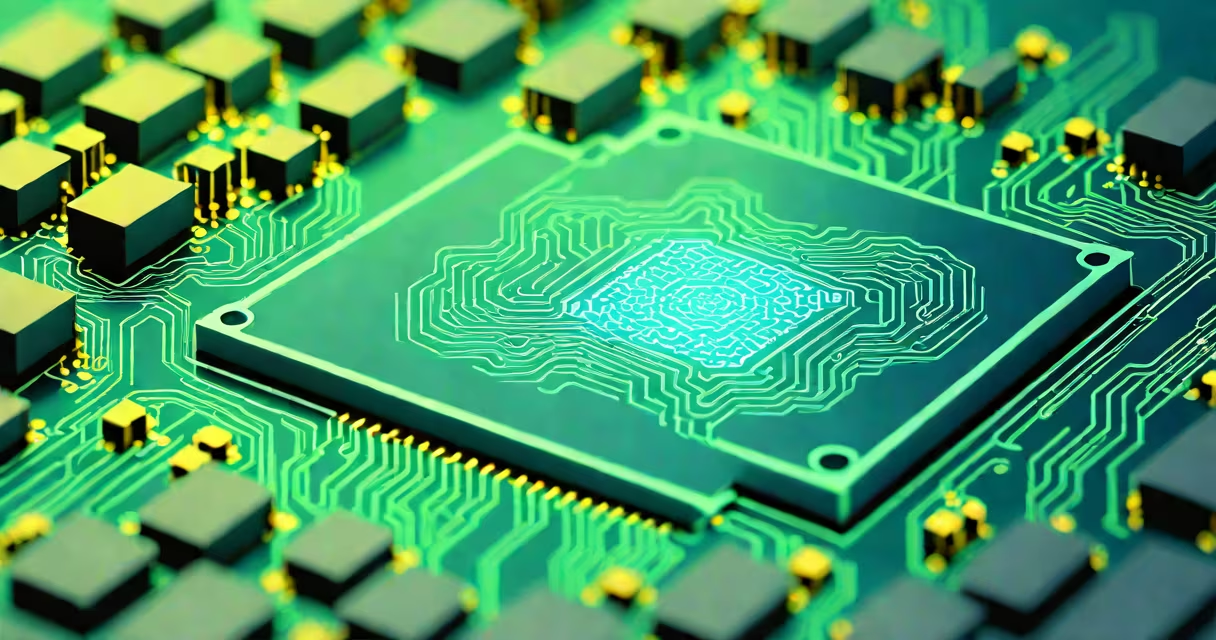
An integrated circuit (IC) is a miniature electronic system fabricated on a single piece of semiconductor material-typically silicon-where thousands to billions of transistors, resistors, and capacitors are interconnected to perform complex functions. It replaces bulky discrete components with compact, high-performance circuits that enable modern computing, communication, and automation.
Integrated circuits are the foundation of nearly all digital devices. A single microprocessor in a smartphone contains over 10 billion transistors etched into a chip smaller than a fingernail. These circuits process signals, store data, and execute instructions at speeds measured in nanoseconds.
The term "integrated" refers to the merging of multiple electronic components into one monolithic structure. This integration reduces size, power consumption, and manufacturing cost while increasing reliability and speed compared to older circuit designs using separate parts connected by wires.
Integrated circuits operate by controlling the flow of electrons through semiconductor materials. Silicon, doped with impurities like boron or phosphorus, forms regions that act as conductors or insulators. By applying voltage to specific points, the IC switches between states-on and off-representing binary data (1s and 0s).
Circuits are designed using computer-aided design (CAD) tools. Engineers lay out logic gates (AND, OR, NOT) and memory cells on a virtual layout. The design is then transferred to a photomask, which projects the pattern onto a silicon wafer coated with photoresist. Ultraviolet light exposes the areas meant to remain, and chemical etching removes the rest, leaving behind the physical circuitry.
After fabrication, each chip undergoes testing. A probe card touches tiny pads on the die to verify correct operation. Defective chips are discarded; working ones are cut from the wafer and packaged for use in consumer electronics.
Integrated circuits fall into two broad categories based on function and complexity:
| Type | Function | Examples | Use Cases |
|---|---|---|---|
| Linear ICs | Amplify analog signals | Operational amplifiers, voltage regulators | Audio systems, power supplies |
| Digital ICs | Process binary logic | Microprocessors, memory chips, logic gates | Computers, phones, IoT devices |
| Mixed-Signal ICs | Handle both analog and digital inputs | ADCs, DACs, sensor interfaces | Cameras, medical monitors, industrial controls |
Within digital ICs, further classification exists by complexity and programmability:
A key insight often missed: not all integrated circuits are created equal. The performance of a chip depends not just on transistor count but on fabrication node size-the smallest feature that can be reliably produced. As of 2023, leading-edge chips use a 3nm process, meaning critical features are about 3 nanometers wide-roughly 100 atoms across.
Integrated circuits appear in virtually every electronic device. They control engine timing in cars, decode video streams in smart TVs, manage battery charging in laptops, and process images in digital cameras.
For example, the Apple A17 Pro chip, used in the iPhone 15 Pro, integrates 19 billion transistors across a 6.5mm × 6.5mm die. It handles machine learning tasks, runs augmented reality apps, and manages display output-all while consuming less than 5 watts of power during typical use.
Medical devices rely heavily on ICs too. Implantable pacemakers use ultra-low-power mixed-signal ICs to monitor heart rhythms and deliver electrical pulses. These chips must operate for years on a single battery charge, requiring precision design and energy efficiency.
One common confusion is equating integrated circuits with printed circuit boards (PCBs). While both are essential in electronics, they serve different roles. A PCB is a flat board with copper traces that connects components like ICs, capacitors, and connectors. An IC is a functional unit embedded within that system. You can't run a computer without a PCB, but you can't compute without an integrated circuit.
As someone who once assembled a DIY weather station using a Raspberry Pi and a temperature sensor, I learned firsthand how much simpler electronics became after the invention of the IC. Before ICs, building even a basic timer required dozens of discrete transistors and resistors. Now, a single IC handles timing, input reading, and communication-all in a package smaller than a dime.
Many assume that integrated circuits are inherently fragile. While they're sensitive to electrostatic discharge (ESD), proper handling during manufacturing and installation prevents damage. Most modern ICs include internal protection diodes and surge suppressors.
Another misconception is that larger chips always mean better performance. In reality, smaller die sizes reduce signal delay and power leakage. The 3nm process node allows faster switching and lower heat generation than older 14nm or 28nm nodes-even if transistor count remains similar.
Some believe all ICs are made in the same factories. In truth, fabrication occurs in specialized facilities called fabs. Companies like TSMC (Taiwan Semiconductor Manufacturing Company) and Samsung Foundry produce chips for clients ranging from Apple to NVIDIA. These facilities cost over $20 billion to build and require cleanrooms with air purity levels exceeding ISO Class 1 standards.
Finally, there's a widespread belief that integrated circuits are purely electronic. But recent advances in flexible and stretchable ICs-using organic semiconductors or thin-film transistors-enable applications in wearable health monitors and biocompatible implants. Research at institutions like Stanford University and MIT explores ICs that conform to skin or internal organs.
Understanding what is an integrated circuit reveals its role not just as a component, but as the core enabler of digital civilization. From the simplest calculator to the most advanced AI accelerator, the integrated circuit delivers computation in a form factor that was unimaginable just decades ago.