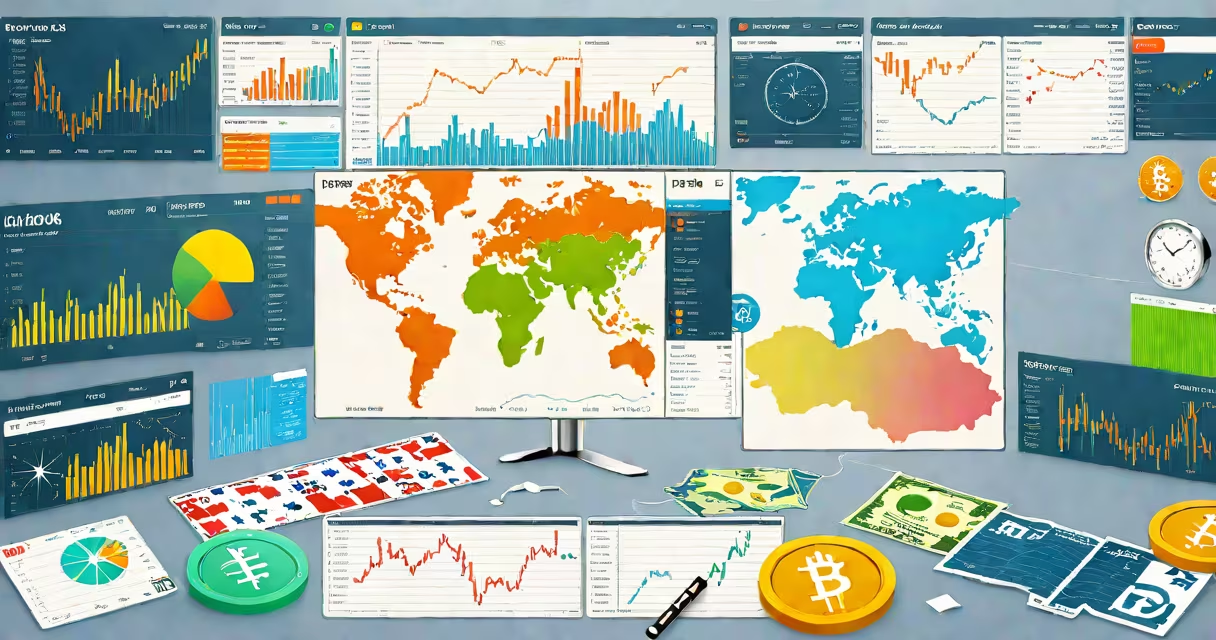
A flexible exchange rate is a system where a country's currency value is determined by market forces-supply and demand-without government intervention. The rate fluctuates daily based on economic indicators, interest rates, trade balances, and investor sentiment. This system contrasts with fixed exchange rates, where governments peg their currency to another asset, such as gold or a major currency.
Under a flexible exchange rate regime, no central authority sets the price. Instead, the market continuously adjusts the value. For example, if demand for U.S. dollars rises due to strong economic growth or high interest rates, the dollar appreciates. If investors lose confidence in a nation's economy, its currency depreciates. This mechanism allows markets to reflect real-time economic conditions.
The International Monetary Fund (IMF) recognizes flexible exchange rates as a standard practice among advanced economies. According to IMF Article IV consultations, countries like the United States, Japan, and members of the European Union operate under floating systems. These nations allow their currencies to move freely in response to global capital flows and trade dynamics.
Flexible exchange rates are set through continuous trading on global foreign exchange (forex) markets. Major financial centers-London, New York, Tokyo, and Singapore-host 24-hour trading sessions. Traders buy and sell currencies based on expectations of future performance, inflation, central bank policies, and geopolitical risk.
For instance, when the U.S. Federal Reserve raises interest rates, foreign investors seek higher returns in U.S. assets. They convert their local currencies into dollars, increasing demand. As demand grows, the dollar strengthens against other currencies. Conversely, if a country runs large trade deficits, its currency may weaken due to excess supply in the market.
Exchange rates are quoted in pairs-such as USD/EUR or JPY/USD-where the first currency is the base and the second is the quote. A rate of 1.10 USD/EUR means one euro buys 1.10 U.S. dollars. These prices update constantly during trading hours, reflecting live market activity.
Flexible exchange rates fall into two categories: pure float and managed float. In a pure float, the currency moves entirely based on market forces with no central bank interference. In a managed float, authorities occasionally intervene to stabilize extreme volatility.
| Type | Definition | Example Countries | Key Feature |
|---|---|---|---|
| Pure Float | Currency value set solely by market supply and demand | United States, Canada, Australia | No central bank intervention |
| Managed Float | Market-driven with occasional central bank actions | India, South Korea, Brazil | Interventions to prevent sharp swings |
India uses a managed float. The Reserve Bank of India monitors the rupee's movement and may sell dollars from reserves to slow depreciation during periods of capital outflow. This prevents sudden crashes while maintaining market-based pricing.
Japan's yen operates under a pure float. In 2022, the Bank of Japan maintained ultra-low interest rates while global rates rose. As a result, the yen weakened -dropping from 110 to the dollar in early 2022 to over 150 by late 2023. This depreciation boosted Japanese exports but increased import costs for energy and raw materials.
Many confuse flexible exchange rates with unstable or unpredictable ones. That's incorrect. Flexibility doesn't imply chaos. A well-functioning market reflects information accurately. Volatility is not inherently bad-it signals adjustment to new data.
Another misconception is that flexible rates harm trade. In reality, they act as automatic stabilizers. When a country's exports rise, its currency appreciates, making exports more expensive and imports cheaper-this helps balance trade over time. The opposite happens when imports dominate.
Flexible exchange rates do not eliminate the role of central banks. Central banks still influence the rate indirectly through monetary policy. Raising interest rates attracts capital inflows, which push up the currency. Lowering rates has the opposite effect. The Bank of England's decision to hike rates in 2022 led to a 6% appreciation of the pound within months.
One non-obvious fact: flexible exchange rates reduce the need for foreign exchange reserves. Countries with fixed rates must hold large reserves to defend the peg. Under a flexible system, reserves are used less frequently. The IMF reports that emerging market economies using floating rates reduced reserve holdings by 20-30% between 2000 and 2020, freeing capital for development.
I once observed a small export business in Vancouver struggle with a sudden 12% drop in the Canadian dollar against the U.S. dollar. The owner initially blamed poor sales. But after reviewing exchange rate history, we realized the decline was due to Fed rate hikes and stronger U.S. employment data. The company adjusted pricing and hedged future transactions using forward contracts. Their profits stabilized within six weeks.
This illustrates how flexible exchange rates affect real businesses. Fluctuations aren't random-they're driven by measurable factors. Companies must monitor them closely to manage risk.
Flexible exchange rates support international capital mobility. Investors can move money across borders knowing that currency values will adjust to reflect underlying economic strength. This encourages investment in developing markets and fosters innovation.
They also prevent persistent trade imbalances. If a country runs a chronic deficit, its currency weakens, making exports cheaper and imports more expensive. This self-correcting mechanism reduces pressure on fiscal policy.
However, rapid fluctuations can disrupt planning. A business expecting stable costs may face unexpected increases in imported inputs. To mitigate this, firms use financial instruments like forwards, futures, and options to lock in exchange rates for future transactions.
For example, a German manufacturer importing semiconductors from Taiwan might enter a forward contract to buy U.S. dollars at a fixed rate three months ahead. This protects against a sudden euro appreciation.
What is flexible exchange rate? It is a market-driven system where currency values adjust daily based on economic fundamentals and investor behavior. It is not synonymous with instability or lack of control. In fact, it provides transparency and responsiveness-key features of efficient financial systems.
When evaluating currency systems, remember: flexibility isn't about randomness-it's about adaptation. The global economy functions better when prices reflect reality, not artificial constraints.