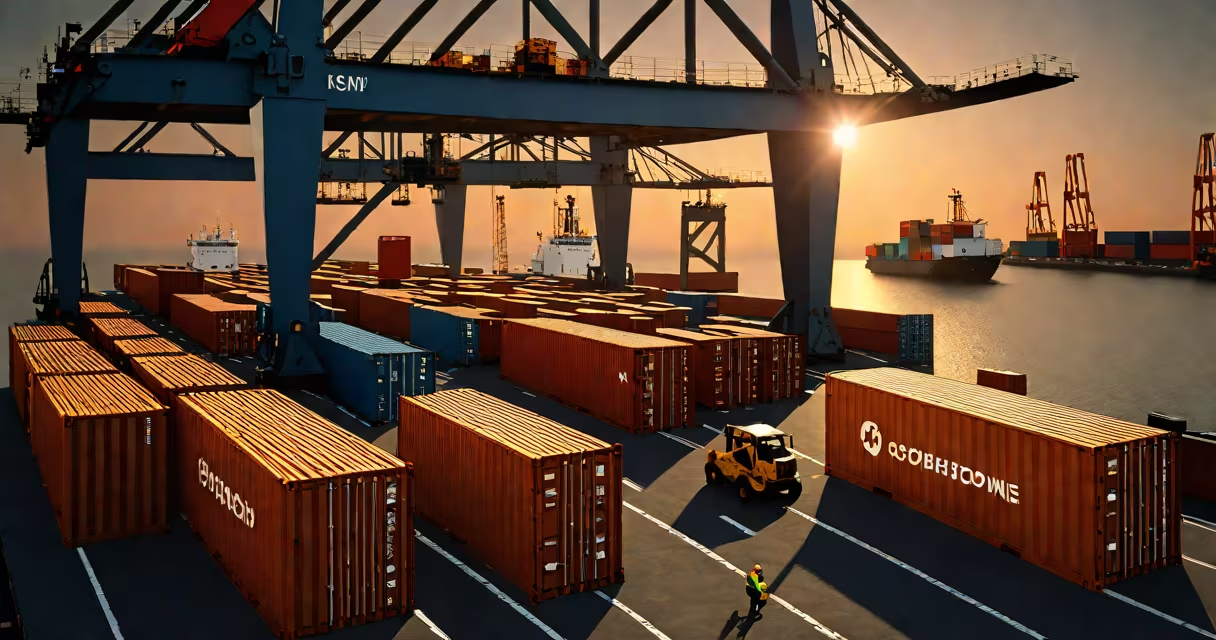
FOB (Free On Board) is an international shipping term under Incoterms® 2020 that defines when ownership, risk, and cost of goods transfer from seller to buyer during international transport. The seller delivers goods to a port and loads them onto a vessel; once the goods cross the ship's rail, responsibility shifts to the buyer.
FOB applies only to sea or inland waterway transport. It specifies that the seller covers costs and risks until the goods are safely loaded onto the ship at the named port of shipment. After that point, the buyer assumes all expenses and liabilities, including freight, insurance, import duties, and unloading.
For example, if a U.S. manufacturer ships 100 custom-made industrial valves to a buyer in Hamburg, Germany via FOB New York, the seller arranges and pays for transporting the valves to the port, loading them onto the ship, and completing export documentation. Once the valves are on the vessel's deck, the buyer takes over. The buyer then pays for ocean freight, insures the cargo, handles customs clearance in Germany, and manages unloading and delivery to their warehouse.
FOB operates through a clear division of responsibility at a specific physical point: the moment goods pass the ship's rail at the port of departure. This threshold determines who bears financial and legal risk at each stage.
The seller's obligations include arranging transportation to the port, preparing export paperwork, obtaining necessary permits, and physically loading the goods onto the vessel. The buyer's responsibilities begin immediately after loading: they pay for ocean freight, arrange marine insurance, handle import customs procedures, and cover unloading and inland transport to the final destination.
Under FOB, the seller is not required to book the vessel or secure freight space. They only deliver the goods to the port and ensure they are loaded. The buyer must coordinate the actual shipping service and manage the logistics from that point forward.
FOB appears in two forms: FOB Origin and FOB Destination. These variants are often used in domestic trade but are misapplied in international contexts. In international shipping, FOB is always tied to a named port.
| Incoterm | Applicable Transport | Point of Responsibility Transfer | Cost Responsibility |
|---|---|---|---|
| FOB Port Name (e.g., FOB Shanghai) | Sea or inland waterway | When goods cross the ship's rail at the named port | Seller: up to loading. Buyer: all after. |
| FOB Origin (domestic) | Land transport | When goods leave seller's facility | Seller: up to pickup. Buyer: all after. |
| FOB Destination (domestic) | Land transport | When goods arrive at buyer's location | Buyer: all costs until delivery. |
Only FOB Port Name applies to international trade. Using "FOB Origin" or "FOB Destination" in export contracts causes confusion and legal disputes because they lack a defined port and do not align with Incoterms® 2020 standards.
Many buyers assume FOB means the seller delivers the goods to their door. That is incorrect. FOB ends at the ship's rail-not at the buyer's warehouse. The buyer must contract for ocean freight, insurance, and customs clearance.
A common mistake is confusing FOB with CIF (Cost, Insurance, and Freight). Under CIF, the seller pays for ocean freight and marine insurance. With FOB, the buyer arranges and pays for both. This difference can result in a $2,500 cost gap for a 20-foot container shipment from China to the U.S. port of Los Angeles.
Another misconception is that FOB includes customs clearance. It does not. Import duties, VAT, and customs brokerage fees fall entirely on the buyer. A shipment from Vietnam to Canada under FOB Ho Chi Minh City requires the Canadian buyer to pay all import charges upon arrival at Vancouver port.
In 2022, a German electronics firm ordered 500 units of high-precision circuit boards from a supplier in Shenzhen, China. The contract specified FOB Shenzhen. The supplier arranged truck transport to the port, handled export documentation, and loaded the boxes onto a container ship bound for Rotterdam.
Once the containers were secured on the vessel, the risk transferred. The German buyer then paid $3,800 for ocean freight, $1,200 for marine insurance, and $2,100 in Dutch import duties. The buyer also hired a customs broker to clear the goods through the EU's customs system.
If the contract had used CIF instead, the Chinese supplier would have covered freight and insurance. The buyer would have saved $5,000 in upfront costs but paid higher product prices to offset the added expense. FOB shifted the financial burden earlier in the process.
FOB reduces ambiguity in international contracts. According to the International Chamber of Commerce (ICC), which publishes Incoterms®, over 60% of global trade contracts reference Incoterms® 2020. FOB remains one of the most frequently used terms due to its clarity and predictability.
However, misuse persists. A 2021 ICC survey found that 34% of small exporters incorrectly applied FOB to air freight or used "FOB" without naming a port. This leads to disputes over who pays for delays, damage, or customs rejection.
Proper use requires specifying the named port: FOB Shanghai, not just "FOB." Without a port name, the term is invalid under Incoterms® 2020. The ICC emphasizes that "FOB is not a standalone term-it must be paired with a port of shipment."
I once managed a supply chain for a U.S.-based medical device company importing surgical tools from South Korea. The initial contract used "FOB Seoul" without specifying whether the port was Incheon or Busan. The Korean supplier assumed Incheon. The U.S. buyer expected Busan. The shipment arrived at the wrong port, causing a four-day delay and $1,800 in demurrage fees.
We resolved the issue by revising the contract to specify "FOB Busan." We also added a clause requiring the seller to confirm the vessel's port of loading within 48 hours of departure. This prevented future errors.
FOB Incoterms defines the exact moment responsibility shifts from seller to buyer during international shipping. The seller covers all costs and risks until the goods are loaded onto the vessel at the named port. After that, the buyer assumes full liability.
FOB applies only to sea or inland waterway transport. It does not cover air freight or road-only shipments. Always pair FOB with a named port-"FOB Shanghai," not "FOB China."
Understanding what is fob incoterms prevents costly misunderstandings. Buyers must budget for freight, insurance, and import fees. Sellers must ensure accurate loading and timely documentation. Clear communication avoids disputes and ensures smooth delivery.