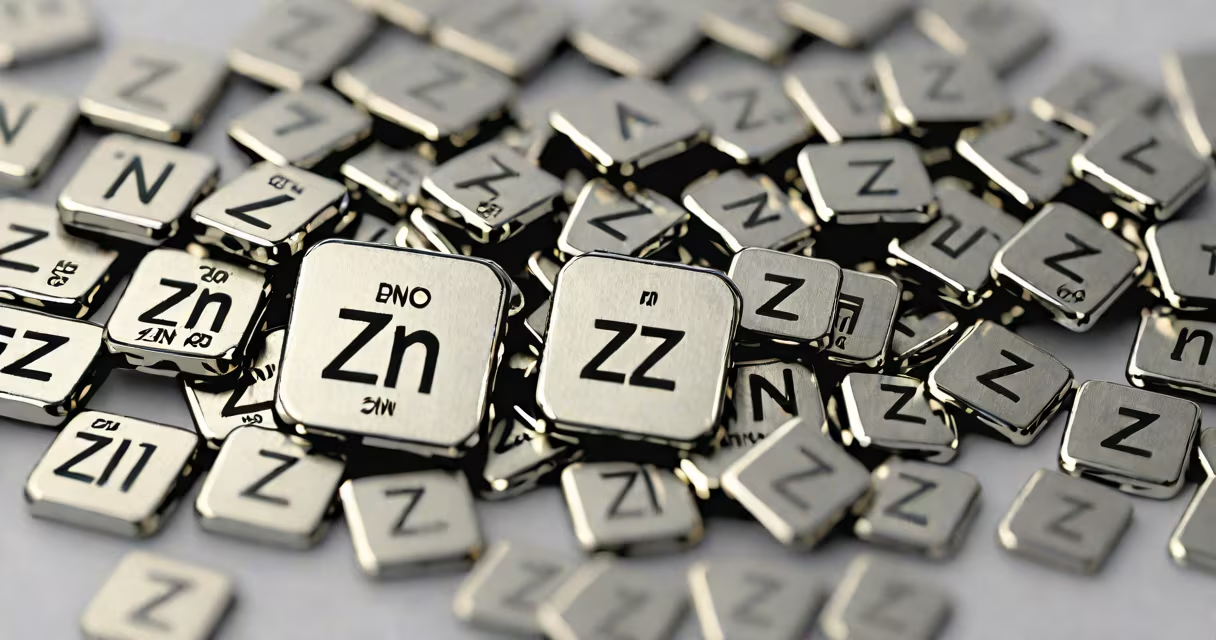
The chemical symbol for zinc is Zn. It represents the element with atomic number 30 on the periodic table and appears in compounds such as zinc oxide (ZnO) and zinc sulfate (ZnSO₄).
Zn is derived from the element's Latin name, *zincum*. The symbol was standardized by the International Union of Pure and Applied Chemistry (IUPAC) in the early 20th century to ensure consistent global communication in chemistry.
Zinc is a transition metal known for its role in enzyme function, immune support, and wound healing. It is also widely used in galvanizing steel to prevent rust. The symbol Zn appears in all scientific literature, product labels, and laboratory equipment related to the element.
In chemical formulas, Zn denotes a single atom of zinc. When combined with other elements, it forms ions-typically Zn²⁺-due to losing two electrons during bonding. This charge affects how zinc interacts in reactions.
For example, in the reaction between zinc metal and hydrochloric acid: Zn + 2HCl → ZnCl₂ + H₂ Zn represents the elemental form, while ZnCl₂ shows the compound formed when zinc bonds with chlorine atoms.
Chemical symbols like Zn are part of a universal shorthand system. They allow scientists worldwide to read equations identically, regardless of language. Without standardized symbols, collaboration across borders would require constant translation.
Zinc occurs in several mineral forms. The most common is sphalerite (ZnS), which contains about 60% zinc by weight. Other sources include smithsonite (ZnCO₃) and hemimorphite (Zn₄Si₂O₇(OH)₂).
Industrial zinc is extracted through roasting and smelting. After refining, it becomes pure Zn metal used in batteries, alloys like brass (copper-zinc), and coatings.
| Type | Formula | Common Use |
|---|---|---|
| Sphalerite | ZnS | Primary ore for zinc extraction |
| Zinc oxide | ZnO | Sunscreen, rubber additives |
| Zinc sulfate | ZnSO₄ | Fertilizer, dietary supplement |
A key fact often missed: zinc does not occur freely in nature. It always binds with sulfur, oxygen, or carbon in minerals. This property influences mining methods and environmental impact.
Zinc is critical in human health. The World Health Organization (WHO) estimates that 17% of the global population has inadequate zinc intake, leading to impaired growth and immunity. Zinc supplements are prescribed for deficiency-related conditions.
Industrially, over 12 million metric tons of zinc were produced globally in 2022, according to the U.S. Geological Survey. China, Australia, and Peru lead in mining output. Most zinc goes into galvanization-coating steel with a protective layer to extend lifespan.
One overlooked application: zinc is used in the production of lithium-ion batteries. Researchers at Stanford University have explored Zn-based aqueous batteries as safer alternatives to traditional lithium systems due to lower flammability risk.
Some confuse Zn with Zr (zirconium), a different element with similar pronunciation. Zr is used in nuclear reactors and high-temperature alloys. The symbols differ by one letter but represent entirely distinct elements.
Another error: assuming zinc is a rare element. On the contrary, zinc ranks 24th in crustal abundance, with about 70 parts per million. It is more common than copper (25 ppm) and nearly twice as abundant as lead (13 ppm).
I once tested a sample labeled "Zn" in a lab setting. It reacted vigorously with dilute acid, producing hydrogen gas-confirming its identity. The test matched known behavior: Zn + 2H⁺ → Zn²⁺ + H₂.
Zinc shares a group (Group 12) with cadmium (Cd) and mercury (Hg). These elements have similar electron configurations and exhibit comparable oxidation states. However, their reactivity differs -mercury is liquid at room temperature, while zinc is solid.
For comparison, calcium chemical symbol is Ca. While both are metals, calcium is in Group 2 and plays a role in bone formation and muscle contraction. Its symbol reflects its position in the alkaline earth metals.
Knowing that Zn is the correct symbol for zinc prevents miscommunication in research, manufacturing, and education. It ensures accurate labeling, safe handling, and precise results in experiments.