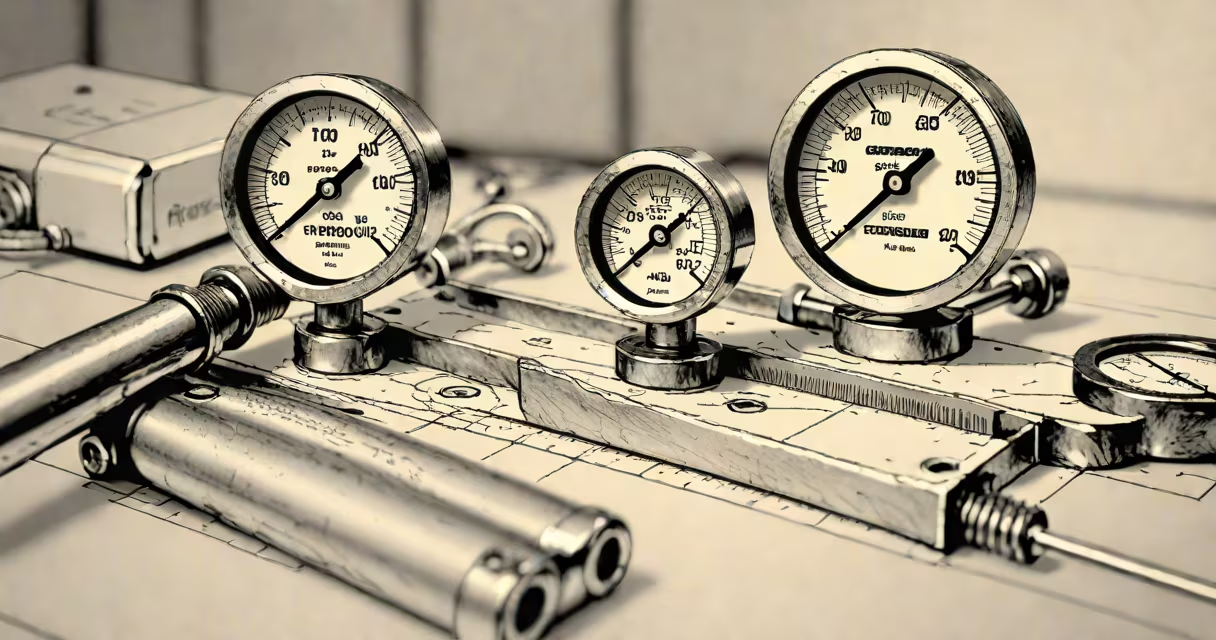
150 psig equals approximately 10.34 bar. This conversion is essential in engineering, industrial systems, and fluid dynamics where pressure values must align across metric and imperial measurement systems.
Psig stands for pounds per square inch gauge, measuring pressure relative to atmospheric pressure. Bar is a metric unit of pressure equal to 100,000 pascals (100 kPa). The conversion factor between psig and bar is 1 psig ≈ 0.0689476 bar. Multiplying 150 by this factor yields 10.34214 bar, which rounds to 10.34 bar for practical use.
Industrial equipment such as compressors, valves, and pressure vessels often list operating pressures in both units. For example, a pneumatic actuator rated for 150 psig must not exceed 10.34 bar in metric systems to avoid failure. Misinterpreting these values risks system damage or safety hazards.
The relationship between psig and bar relies on standardized international definitions. The pound-force per square inch (psi) is based on avoirdupois units, while bar derives from the metric system. Since 1985, the International System of Units (SI) defines bar as exactly 100,000 pascals, making conversions precise and repeatable.
To convert any psig value to bar, apply the formula:
bar = psig × 0.0689476For 150 psig:
150 × 0.0689476 = 10.34214 barRounded to two decimal places, this becomes 10.34 bar. This precision ensures compatibility across global manufacturing standards.
Some systems use absolute pressure (psia), which includes atmospheric pressure. However, psig excludes atmospheric pressure, making it ideal for measuring pressurized systems like air tanks and hydraulic lines. Always confirm whether a reading is gauge (psig) or absolute (psia) before converting.
Pressure is measured in several units depending on region and application. The most common include psi (imperial), bar (metric), kPa (kilopascal), and MPa (megapascal).
| Unit | Definition | Common Use Cases |
|---|---|---|
| psig | Pounds per square inch gauge (relative to atmosphere) | US industrial tools, HVAC systems, tire pressure |
| bar | 100,000 pascals; ≈1 atm | European engineering, scuba gear, weather reports |
| kPa | 1,000 pascals | Scientific research, medical devices, SI compliance |
| MPa | 1,000,000 pascals | High-pressure testing, materials science, aerospace |
Bar is widely adopted in Europe and Asia due to its simplicity and alignment with SI units. A pressure of 10.34 bar is equivalent to 1,034 kPa or 0.1034 MPa. Engineers working internationally must convert between these units to ensure design consistency.
When selecting instruments, verify the display unit. A pressure transducer labeled "0-150 psig" may also show "0-10.34 bar" on its digital readout. Mismatched units cause errors during calibration and maintenance.
Many assume that 1 bar equals 14.7 psi, but this is incorrect. 1 bar is approximately 14.5038 psi, not 14.7. The value 14.7 psi corresponds to standard atmospheric pressure (1 atm), which is slightly less than 1 bar (1.01325 bar).
A frequent error is confusing psig with psia. Psig measures pressure above ambient; psia includes atmospheric pressure. For example, a tank at 150 psig contains 164.7 psia (150 + 14.7). Converting psia to bar requires adjusting for atmospheric pressure first.
Another misconception is treating bar as interchangeable with atmosphere (atm). While 1 atm ≈ 1.01325 bar, they are not equal. Using 1 bar = 1 atm leads to a 1.3% error, which compounds in high-precision systems like semiconductor manufacturing or deep-sea submersibles.
During a maintenance check on a compressed air system, I once saw a technician set a regulator to 10 bar based on a manual stating "150 psig = 10 bar." The actual value was 10.34 bar. The resulting pressure surge damaged downstream sensors. Correcting the value restored system stability.
An industrial air compressor operates at 150 psig. The manufacturer's specifications list the maximum discharge pressure as 10.34 bar. The control panel uses bar for display and alarms.
To verify proper operation, a technician checks the pressure using a calibrated digital gauge. The gauge reads 10.34 bar. They cross-check against the original 150 psig specification. Using the formula:
10.34 ÷ 0.0689476 ≈ 149.99 psigThe result confirms the system is within tolerance. Any deviation beyond ±0.5 psig triggers a fault alarm.
This example shows why accurate conversion prevents equipment failure. In a facility with 40 such compressors, even a 1% error in pressure settings increases energy consumption by 3-5% annually, according to the U.S. Department of Energy's Energy Efficiency and Renewable Energy Office.
For reference, the National Institute of Standards and Technology (NIST) provides official conversion tables for pressure units. Their Metric System Introduction details the exact relationships between units, including psig to bar.
Understanding 150 psig to bar is not just about math-it's about safety, efficiency, and compliance. Whether designing a new system or troubleshooting an existing one, correct unit conversion prevents costly downtime and potential accidents.
Always verify the unit type (gauge vs. absolute), use precise conversion factors, and double-check values in critical applications. The difference between 10.34 bar and 10.00 bar is 3.3%, enough to affect performance in sensitive environments.