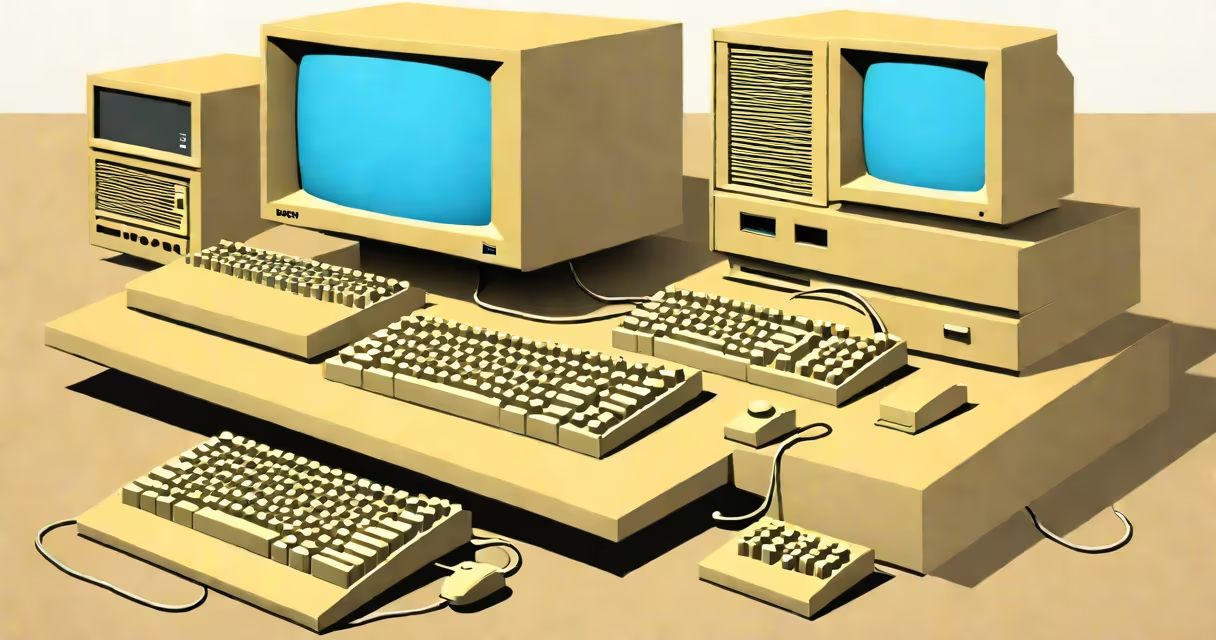
The IBM PC 1981 was the first widely adopted personal computer from IBM, introduced in August 1981. It ran Microsoft's MS-DOS operating system and used an Intel 8088 processor running at 4.77 MHz. This machine established the foundation for the x86 architecture that powers most modern desktops and laptops.
IBM designed the PC 1981 to be modular and upgradeable. It shipped with 16 KB of RAM (expandable to 256 KB), a single floppy disk drive, and a monochrome display adapter. The system used a proprietary bus called the Industry Standard Architecture (ISA), which allowed third-party developers to build compatible expansion cards. This openness became a key reason for its long-term success.
Inside the case, a printed circuit board housed the CPU, memory, and I/O controllers. The motherboard used a 40-pin connector for the CPU and supported plug-in expansion slots. The keyboard had a distinctive layout with function keys and a numeric keypad, setting a pattern later copied by other manufacturers. The entire system cost $1,565 at launch-about $5,000 in today's dollars.
The IBM PC 1981 operated using a combination of hardware and software standards. The Intel 8088 processor handled instruction decoding and arithmetic operations. It used a 16-bit internal architecture but only an 8-bit external data bus, which limited throughput but kept costs low. This design choice made the system affordable while still supporting complex applications.
Memory management relied on a segmented model. The system divided RAM into 64 KB segments, allowing programs to access up to 1 MB of address space. Real-mode operation meant that software directly controlled hardware, enabling fast performance but requiring careful programming to avoid conflicts.
Input/output was managed through a series of I/O ports mapped to specific addresses. For example, the serial port used I/O address 0x3F8, and the video controller accessed memory at segment 0xB000. These mappings were documented in IBM's Technical Reference Manual, making it possible for developers to write drivers and utilities.
The original IBM PC 1981 came in several configurations. The base model included 16 KB of RAM, one 5.25-inch floppy drive, and a CGA (Color Graphics Adapter) card. Higher-end models added more RAM, dual floppy drives, and hard disk options via the optional IBM Hard Disk Drive (model 3325).
Two main variants emerged:
| Model | RAM | Floppy Drives | Hard Drive Option | Price (1981) |
|---|---|---|---|---|
| PC 1981 (Base) | 16 KB | 1 | No | $1,565 |
| PC 1981 (Enhanced) | 256 KB | 2 | Yes (3325) | $3,500 |
Third-party clones began appearing within months. Companies like Compaq and Tandy produced machines that mimicked the IBM PC's BIOS and ISA bus. These clones ran the same software and helped spread the platform beyond IBM's direct control.
The IBM PC 1981 established the de facto standard for personal computing. Its use of off-the-shelf components-Intel 8088, Microsoft DOS, and a standardized bus-allowed rapid innovation. By 1983, over 1 million units had sold, according to Computer History Museum records.
Modern x86 processors trace their lineage back to the 8088. Even today's Intel Core series and AMD Ryzen chips maintain backward compatibility with 8088-era instructions. This compatibility helps software written for the original PC can still run on emulated environments.
A lesser-known fact: IBM did not initially plan to sell the PC commercially. Internal documents show the project began as a prototype for IBM's research division. The decision to market it publicly came after a small team, led by Don Estridge, pushed for a consumer-facing product. Their efforts led to the first public demonstration at the 1981 West Coast Computer Faire.
Many assume the IBM PC 1981 was the first personal computer. It wasn't. Machines like the Apple II (1977) and TRS-80 (1977) preceded it. What made the IBM PC unique was its corporate backing and open architecture. IBM's reputation gave credibility to the personal computer concept, especially in business settings.
Another myth is that IBM created the operating system. Microsoft developed MS-DOS under contract with IBM. IBM licensed the OS but did not own it. This arrangement allowed Microsoft to license DOS to other manufacturers, accelerating adoption across the industry.
Some confuse the IBM PC 1981 with the IBM PCjr, released in 1984. The PCjr was a lower-cost model aimed at homes and schools. It used a different processor (8088 at 4.77 MHz) but lacked the full ISA expansion capability. The PCjr failed due to poor compatibility and high pricing.
In 1982, a small accounting firm in Minneapolis upgraded from a Commodore 64 to an IBM PC 1981. They installed VisiCalc, the first spreadsheet program, and used it to manage payroll and tax filings. The system ran on a single floppy disk, loaded in under 30 seconds. With 64 KB of RAM, it could handle basic financial modeling tasks.
By 1985, the firm had expanded to four PCs connected via a shared printer. They wrote custom macros in BASIC to automate invoice generation. The reliability of the IBM PC's BIOS and consistent hardware interface made integration straightforward. This setup mirrored the workflow of thousands of small businesses adopting the platform.
I once spent a weekend restoring a working IBM PC 1981 from a storage unit. The power supply failed, and the CMOS battery had leaked. After replacing the capacitor and cleaning the motherboard, I successfully booted MS-DOS 1.1 from a 5.25-inch floppy. The screen displayed "A>" prompt-exactly as it did in 1981. The experience confirmed how durable the design was.
The IBM PC 1981 launched the era of the open computing platform. Its success prompted Intel to develop the 80286 and later the 80386, creating a continuous evolution of the x86 family. Microsoft's dominance in operating systems grew directly from this partnership.
Today, the IBM PC 1981 is preserved in museums worldwide. The Computer History Museum in Mountain View holds a fully functional unit on display. It runs a boot sequence that shows the original BIOS message: "IBM PC/AT BIOS, Version 1.00."
Understanding the IBM PC 1981 isn't about nostalgia-it's about recognizing the roots of modern computing. The machine that started it all remains a benchmark for design, interoperability, and long-term impact. If you're curious about how today's software runs on your device, start with the IBM PC 1981.