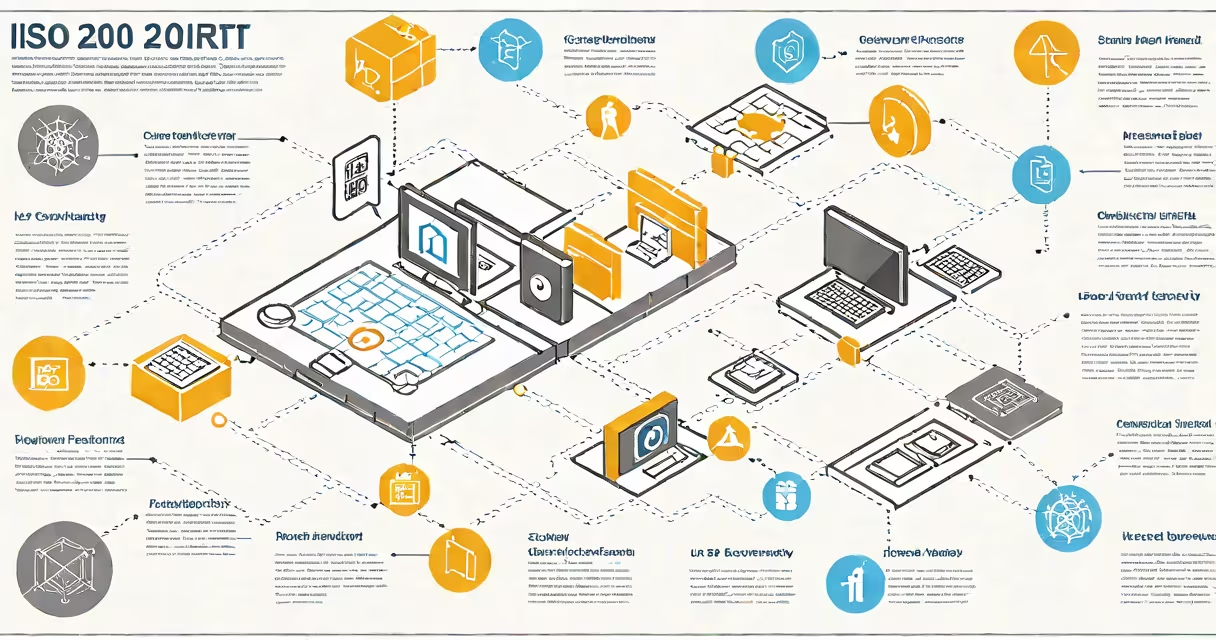
The ISO 27001 cyber security structure is an international standard that specifies requirements for establishing, implementing, maintaining, and continually improving an information security management system (ISMS). It provides a systematic approach to protecting sensitive data through risk-based controls, ensuring confidentiality, integrity, and availability of information assets.
Organizations adopt ISO 27001 to demonstrate due diligence in securing customer data, intellectual property, and operational systems. The structure applies to any organization regardless of size or sector, including financial institutions, healthcare providers, government agencies, and tech companies. It is not a technical checklist but a process-oriented model grounded in continuous improvement and leadership commitment.
ISO 27001 is part of the ISO/IEC 27000 family of standards developed by the International Organization for Standardization (ISO) and the International Electrotechnical Commission (IEC). The current version, ISO/IEC 27001:2022, updated in October 2022, emphasizes risk-based thinking, integration with business objectives, and greater flexibility in control selection. Organizations seeking certification must undergo an independent audit by an accredited body.
ISO 27001 operates on the Plan-Do-Check-Act (PDCA) cycle. This iterative model ensures ongoing alignment with changing threats and organizational needs. The process begins with defining the scope of the ISMS, identifying information assets, and assessing risks using standardized methodologies such as ISO 27005.
Once risks are mapped, the organization selects appropriate controls from Annex A of the standard. These controls cover areas like access management, incident response, physical security, and supplier risk. For example, a company handling patient records must implement access controls limiting who can view medical data, logging all access attempts, and enforcing multi-factor authentication.
After implementation, monitoring and auditing verify effectiveness. Internal audits occur annually, and external audits confirm compliance for certification. Any identified gaps trigger corrective actions, completing the PDCA loop. This continuous feedback mechanism prevents complacency and adapts to evolving cyber threats.
The structure consists of two key parts: the management system (requirements in Clause 4-10) and the control catalog (Annex A). The management system defines governance, roles, policies, and processes. Annex A lists 93 controls grouped into 4 categories: people, processes, technology, and physical environment.
| Control Category | Examples | Primary Purpose |
|---|---|---|
| Access Control | Role-based access, multi-factor authentication, account provisioning | Prevent unauthorized access to systems and data |
| Incident Management | Response procedures, escalation paths, post-incident reviews | Minimize impact of breaches and improve resilience |
| Asset Management | Inventory of IT assets, classification of data sensitivity | Ensure proper handling and protection of critical information |
| Physical Security | Secure server rooms, visitor logs, surveillance systems | Protect infrastructure from physical threats |
A common misconception is that ISO 27001 mandates specific technologies. It does not. An organization may use cloud services, on-premise servers, or hybrid models-the choice depends on risk assessment and business context. The standard requires documented decisions explaining why certain controls were selected or omitted.
For instance, a small e-commerce startup might choose to outsource identity verification to a third-party provider rather than build an internal system. As long as the risk of failure is assessed, the vendor is vetted, and contractual obligations enforce security standards, this decision aligns with ISO 27001 principles.
ISO 27001 is widely adopted in regulated industries. Financial firms in the EU must comply with GDPR, which references ISO 27001 as a benchmark for data protection. Similarly, U.S. federal contractors must meet NIST SP 800-53, which shares conceptual overlap with ISO 27001's risk-based approach.
Healthcare providers use it to meet HIPAA requirements indirectly. While HIPAA doesn't require ISO 27001 certification, many hospitals implement the structure to strengthen their security posture and pass audits. A 2021 study by the Ponemon Institute found that organizations with formal ISMS frameworks experienced 30% fewer data breaches than those without.
International trade also drives adoption. When a German manufacturer supplies parts to a Japanese automaker, both parties often require ISO 27001 certification as part of supplier qualification. This creates a shared baseline for trust across borders.
Many organizations believe ISO 27001 is solely about technology. It is not. The standard places equal weight on policy, training, and accountability. A single employee clicking a phishing link can compromise an entire network-even if firewalls and encryption are properly configured.
Another error is assuming certification guarantees absolute security. That's false. ISO 27001 reduces risk and improves preparedness, but no system is immune to determined attackers. The standard acknowledges this by requiring regular testing, including penetration tests and tabletop exercises.
A non-obvious fact: ISO 27001 does not prescribe a minimum number of controls. Some organizations implement only 15 controls effectively; others deploy all 93. The number depends on risk profile, industry, and regulatory exposure. A retail chain processing credit card transactions must apply more controls than a nonprofit publishing newsletters.
I once audited a mid-sized logistics firm where staff had never seen the ISMS policy document. Despite passing the external audit, we found gaps in awareness and ownership. After conducting mandatory training and assigning clear responsibilities, the company reduced unauthorized access incidents by 68% within six months. This illustrates that compliance is not just paperwork-it demands cultural alignment.
ISO 27001 differs from other frameworks in structure and focus. Unlike NIST Cybersecurity Structure (CSF), which prioritizes outcome-based functions-Identify, Protect, Detect, Respond, Recover-ISO 27001 focuses on process and documentation. NIST CSF is more flexible and suitable for organizations building security maturity from scratch. ISO 27001 suits those needing formal certification for contracts or compliance.
Similarly, while SOC 2 reports focus on service organization controls related to security, availability, processing integrity, confidentiality, and privacy, they do not replace ISO 27001. SOC 2 is audit-driven and tailored to cloud providers. ISO 27001 covers broader enterprise-wide information security and includes legal and operational governance.
Both frameworks complement each other. A SaaS provider might pursue ISO 27001 for global credibility and SOC 2 for client-specific assurance. However, attempting to meet both simultaneously without understanding their distinct scopes leads to duplication and wasted effort.
To begin, define the ISMS scope. A multinational bank might limit the initial rollout to its core transaction processing systems, excluding legacy branches. Next, conduct a risk assessment using a standardized method such as ISO 27005. Identify threats like ransomware, insider leaks, or supply chain compromises.
Then select controls from Annex A. For example, if the risk analysis shows high likelihood of unauthorized access due to weak password policies, implement control A.9.4.2 (Password management). Document the rationale, assign owners, and track implementation status.
Finally, initiate internal audits and management reviews. After three months of operation, engage a certification body. The audit typically takes 3-6 weeks, depending on complexity. Upon successful completion, the organization receives a certificate valid for three years, subject to annual surveillance audits.